I’ve long been interested in the Shibori technique and found this blog post so interesting! So interesting, in fact, I wanted to share the beautiful images and information on my blog.
This is a guest post by Kim of Flextiles. She recently attended the Tenth International Shibori Symposium and I thought you all might to get a glimpse of what she did and saw there. There will be a second post in February. Thanks Kim! Last November, I attended the 10th International Shibori Symposium (hereafter referred […]
Last year, my mother passed away in her sleep without a Will. Becoming the Administrator of her Estate was a lengthy process, but nothing compared to the unknown obstacles I would be forced to deal with it. With my husband by my side, we faced each situation with tenacity and common sense, never loosing focus on what really matters, while maintaining our lifestyle. My continued exploration in the world of knitting, exercise, and photography keeps me grounded.
Photo Credit: Mary Lou Fall
Capturing rain drops on persimmons hanging from a tree outside my studio window.
Photo credit: Mary Lou Fall
Hiking while coping with one of the worst storms this year in Northern California. At least, the drought is officially over. I look forward to planting sunflowers this year.
Photo credit: Mary Lou Fall
Playing around with the color wheel observing the interaction between colors using a knitting pattern of slip stitches.
Today is a day void of unnecessary noise. A day so peaceful, I can hear myself think. No streaming Netflix, texting, working out at the gym or listening to music. I can hear myself turn the pages of one of my favorite knitting books looking for something new to knit, along with the tapping of my laptop keyboard as I write this post.
Within the last week, I’ve discovered how small the world of creativity has become. For the last five years, I’ve attempted to use my blog to fill a large empty space in my heart. I wanted to channel my energies into something positive, and not dwell on a not so pleasant situation. So, I exposed my creative self to the world through this blog. I viewed my blog as a means of communication and education about what interests me, hoping along the way, someone else would enjoy this journey. I’ve always been cognizant to give credit where credit is due. If I post a picture, I site the source. If I reference a book, I credit the author and publisher. But of course, I don’t own a large yarn distribution company, and I haven’t written a book (even though I could), nor do I pound the pavement looking to teach at my LYS (been there done that).
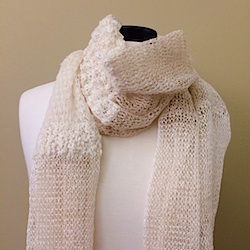
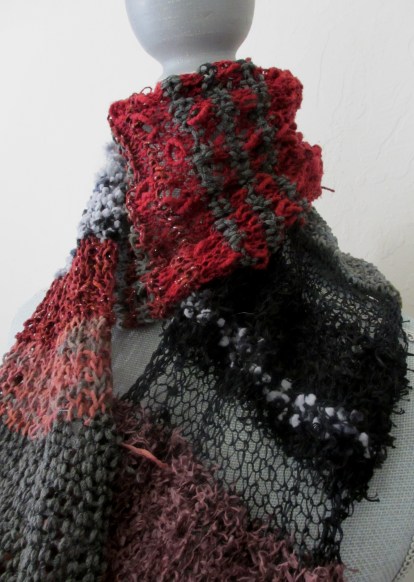
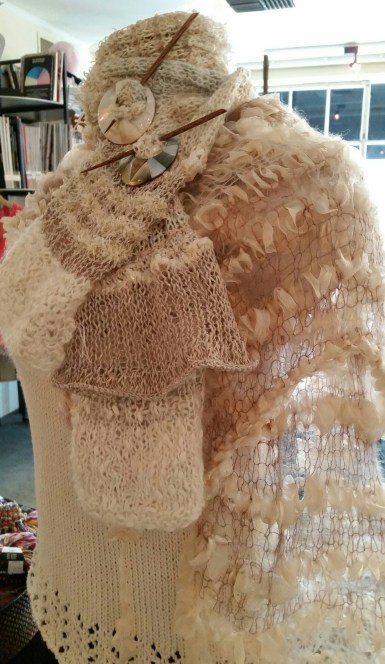
This is such a beautiful new scarf kit “Hagire” from Habu Textiles. I too was inspired by Habu yarn in 2013.
Photo credit: Mary Lou FallPhoto credit: Mary Lou FallPhoto credit: Mary Lou Fall
*The above pictured scarf is my design using Habu Textiles and the shawl is Loopy and Luscious found at Knitty.com
Unlike the designers at Habu, I wasn’t trying to use up leftover yarn, my use of HabuTextiles highlighted the unique qualities of combining and playing with texture and color.
It’s been said, “Imitation is the best form of flattering.” Well, “I’m over it!” How about, “Give credit where credit is due” or perhaps “Design with a conscience.”
There are many knitwear designs that capture my interest, especially cocoknits. Recently, I had an opportunity to sign-up for a series of class meetings with Julie Weisenberger of cocoknits at A Verb for Keeping Warm in Oakland, CA. Julie brought samples to class for all of us to try on, and I was immediately attracted to the long version of Gisela. Knit with HabuTextiles#A-174 Cotton Gima (100% cotton, 1 oz. 265 yards) “Gisela with seams is a cocoknits’ classic; open weave with architectural shaping that adds a bit of drama while hiding what needs to be hidden!”
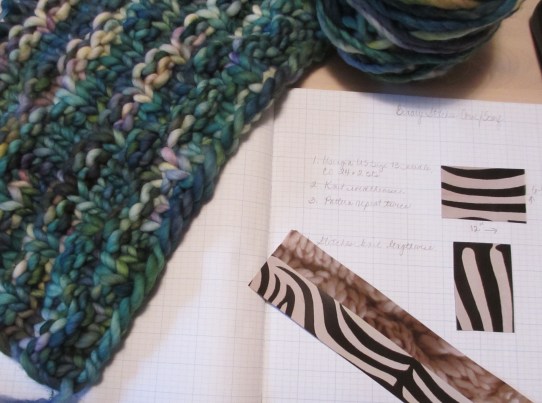
I need to determine if the long version of Gisela is the right length for me. Gisela measures 30″ down from the armhole, which is perfect and lightly touches the top of my knee. Also, I am one size larger on the bottom than the top. What is my next step? How am I going to figure all of this out? Here’s how I incorporated my unique design characteristics…
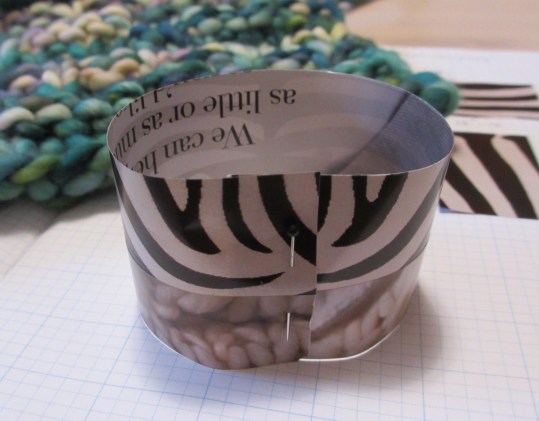
Two paper rectangles representing the measurement from under the armhole and lower body with length measurements for a total of 30″ *not including the yoke.
Where would I start decreasing, and how many decreases would I work? I wanted to tackle the most difficult question of where would I place the decreases. How many rows would I knit before decreasing? This is when I had an “aha moment.” I pulled out my skirt sloper to figure out where to begin decreasing. My hips fall 8″ below my waistline, so I decided to begin decreasing after knitting 10″ from the bottom.
Next, how many stitches do I need to decrease? I chose to knit a large on the bottom and a medium on the top, so I cast on 182 stitches knowing that I would have to decrease to 166 stitches to begin knitting the upper half of the pattern.
The Knitter’s Guide to Sweater Design by Carmen Michelson and Mary-AnnDavis proved to be a plethora of valuable information, especially a section on Reverse Tapered Body, pgs. 69-74 . I read between the lines and “cherry picked” what information I needed.
(Size L) CO 182 sts – (Size M) 166 sts = 16 sts decrease over 8″
8″ x 4 rows (refer to pattern gauge) = 32 rows
16 sts divided by 2 = 8 sts
32 rows divided by 8 = 4 rows
Decrease 2 sts every 4 rows
Of course, this is what I’m going to try, but perhaps you have another approach. By all means, go with your own plan.
Here’s my favorite picture of Super Moon 2016 on a foggy Northern California evening.
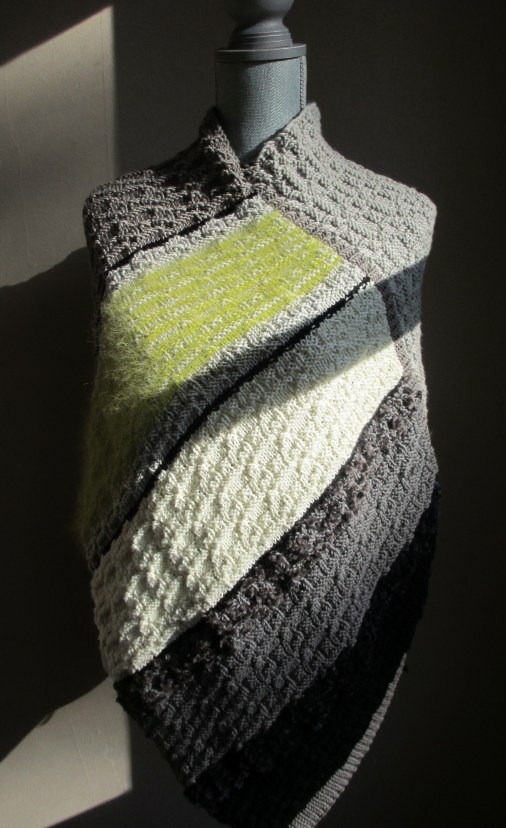
Here’s my latest knitted garment for body adornment using Binary Stitch #4. For this knitted item, I looked to the works of Piet Mondrian and the aesthetics of Minimalism for inspiration.
Piet Mondrian NY MoMA
The definition of Minimalist art of the 1960s described as seriality, succession, progression, repetition permutation also applies to my concept, knitting with Binary Stitches. Encoding letters as binary numbers creates an original design using knit and purl stitches. Knitting the assigned knit and purl stitches builds a basic block, and through repetition, forms a sculptural grid-like appearance.
Even though each knitted rectangular plane is separated by a black line, the plane itself is not contained on all four sides by a black line.. Each plane is knitted without an exact pattern repeat producing an asymmetrical balance.
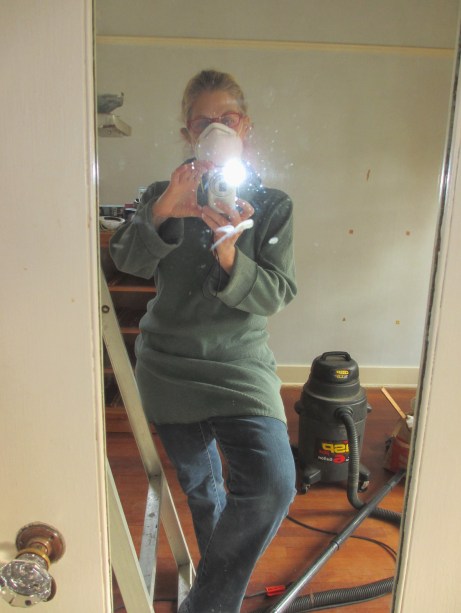
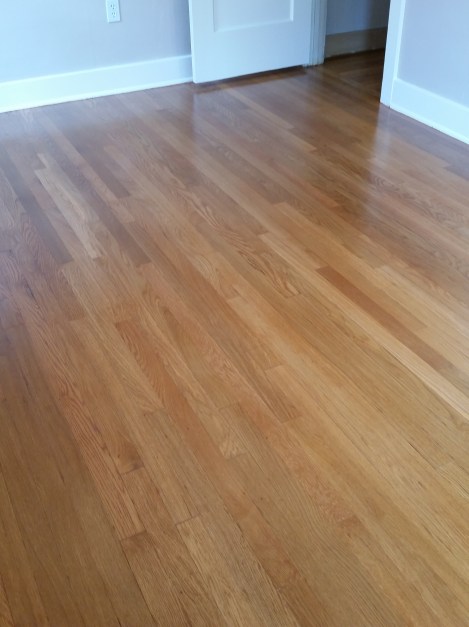
It’s been a few days since my last post, but for the last nine months, in between my sewing and knitting projects, I’ve been involved in a DIY project. I decided to convert our spare bedroom into my studio space. I pulled up old carpet, filled plaster cracks, sanded molding and painted. The floors also needed to be professionally refinished.
It’s amazing what a fresh coat of paint and determination can accomplish.
Newly refinished floors.
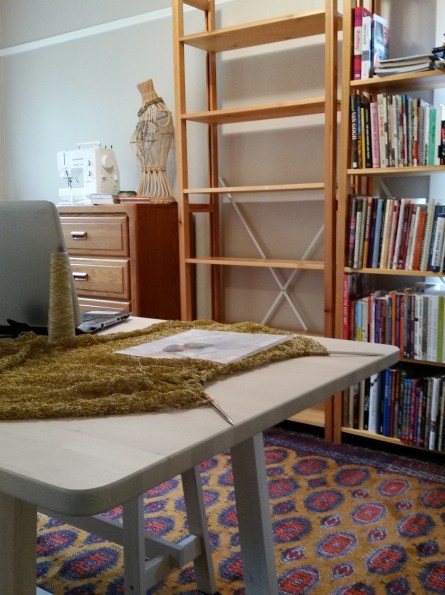
My Studio
Deciding to convert our spare bedroom was not an easy decision, but after being vacant for five years, I decided it was time to create a space for me. A positive enriching environment filled with my favorite things…yarn, books, fabric and ideas.
Every once in awhile, I put down my knitting needles and pick-up a block of polymer clay. A dear friend of mine, Debbie Anderson, teaches interesting classes using the medium. Debbie and I, about 21 years ago, were two of the founding members of the South Bay Polymer Clay Guild in San Jose, California.
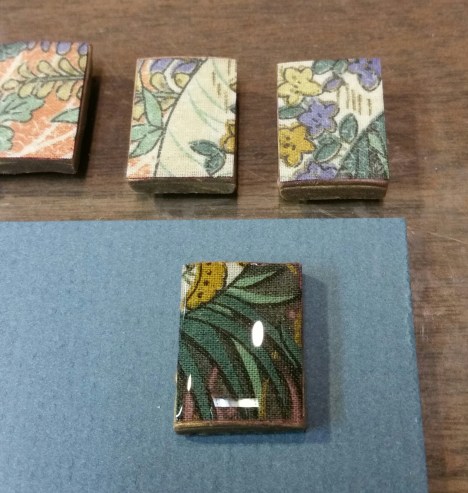
Here are a few photos highlighting the tile bracelet technique:
Both sides of a fabric strip were treated with fabric stiffener, and left to dry for a couple of days.Once a channel for elastic cord was constructed and a backing sheet of polymer clay was applied, the tiles were cut apart and liquid polymer was applied to the fabric surface of the tile.After the tiles were processed in the oven, gloss was added to the surface of each tile.The tiles were strung with seed beads and a hand sculpted toggle using polymer clay.Texture was added to the back of the tiles using an unmounted rubber stamp.Photo credit: Mary Lou Fall
Yesterday, while revisiting familiar territory, I began to reflect on my various artistic experiences with polymer clay and my own artistic growth.
Last week was definitely a busy week. On Tuesday, I trekked up to San Francisco to view, On The Grid: Textiles and Minimalism.
“Minimalist art is based upon pre-existing systems that conceive of the artwork in advance of its actual execution. These systems, often mathematical, rely on the repetition of simple forms. Textiles by their very nature align with these core elements and textile artists, like the Minimalist artist, predetermine the finished work through their selection and processing of materials and in the warping or preparing the loom.” – de Young Museum
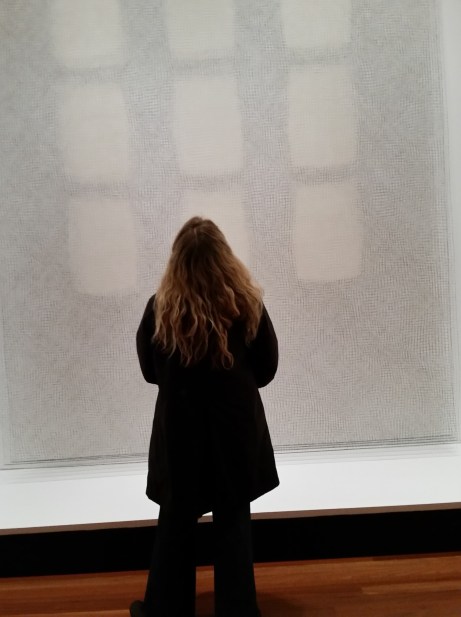
I was particularly interested in Contemporary artist Rebecca R. Medel (American, b. 1947) Wall ofWindows, 1990, cotton, linen; knotted netting, warp and weft resist dyeing (ikat). Rebecca R. Medel began her career in the early 1980s and was influenced by Minimalist artists Agnes Martin and Sol Le Witt. The de Young describes the Wall of Windows installation as,”Using the time-consuming and meditative technique of combining knotted netting with double-ikat dyeing, she creates ethereal installations that vacillate between form and formlessnes.” Medel mentions, “My work is about the spiritual, about infinity, about other than this physical plane of existence.”
Wall of Windows (1990), Contemporary artist Rebecca R. MedelThe many layers of Wall of Windows, 1990 (side view)
The definition of Minimalist art of the 1960s described as seriality, succession, progression, repetition permutation also applies to my concept, knitting with Binary Stitches. Encoding letters as binary numbers creates an original design using knit and purl stitches. Knitting the assigned knit and purl stitches builds a basic block, and through repetition, forms a sculptural grid-like appearance.
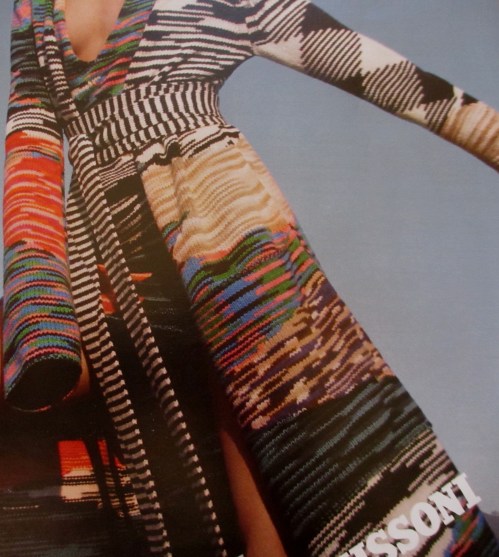
A couple of weeks ago, I came across an advertisement in the August 21, 2016 issue of The New York Times Style Magazine from Missoni. It’s no secret I’m in love with anything Missoni. I’m am so excited to share this with you for another reason…
Photo credit: Missoni and The New York Times Style MagazinePhoto credit: Missoni and The New York Times Style Magazine
Now, I know what to do with all the self-patterning sock yarn I’ve collected over the years for socks that didn’t happen. Doesn’t it look like I may have a couple that match Missoni’s? Of course, the coat above was knitted by machine, but it might be fun to hand knit my very own.

























 Sticks-a-GoGo
You must be logged in to post a comment.