I wanted to title this post “Hand Knitting Meets The Industrial Revolution,” but I realized yarn is spun using a machine too. I recently completed two classes in Fashion Design at Canada College located in Redwood City, California, one of which was Flat Pattern Design. The other class, “Designer Techniques” discussed different ways to refashion an existing pattern and make it your own.
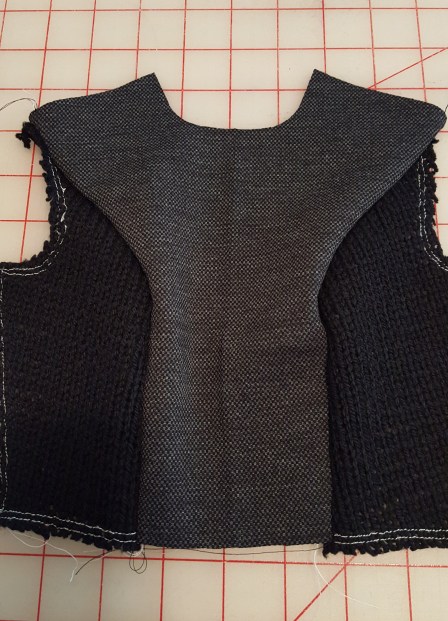
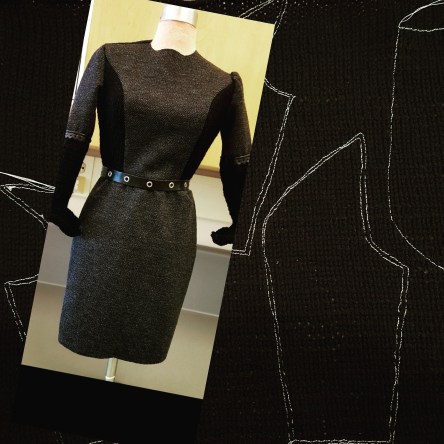
Demonstrating a technique not covered in class was one of the course requirements. I elected to combine hand knitting with fabric. For the sample, I incorporated techniques from Flat Pattern Design and drafted a half scale dress with princess seams.
The pattern pieces are pinned to the hand knit and traced with two rows of stitching using a teflon foot.
An alternative technique would be to baste a line of stitches on your fabric using sturdy thread. With your knitting needles, pick up into the stitches and knit down to create an attached piece of knitting.
In order to eliminate bulk from seams, position the knit fabric with an 1/8″ to 1/4″ seam allowance on the hand knit and 1/2″ seam allowance on the fabric.
Combining hand knit with fabric is an idea I’ve been thinking about for quite some time. “Designer Techniques” was the perfect venue which presented an opportunity for me to take my idea of combining hand knit and fabric a reality.
Wow! I can’t believe how long it’s been since my last post. It all began in August of last year…
At the end of August 2017, I decided to enroll in a Fashion Design Program at a not so local community college. Immediately, I was thrust into the lanes of commute traffic arriving at my location at least an hour before class two mornings a week. Surrounded by an interesting group of like-minded individuals, I learned so much about the material and myself.
Flat Pattern Design was an intense, rigorous class with a language all its own. The process of translating a two-dimensional design into a garment was challenging and at the same time, a rewarding experience.
Flat Pattern Design
Above is a sample of various half scale and quarter scale dart manipulations I produced. The final project for class consisted of using a basic bodice, sleeve and skirt sloper, along with various dart manipulations, in order to design a garment.
Final Garment
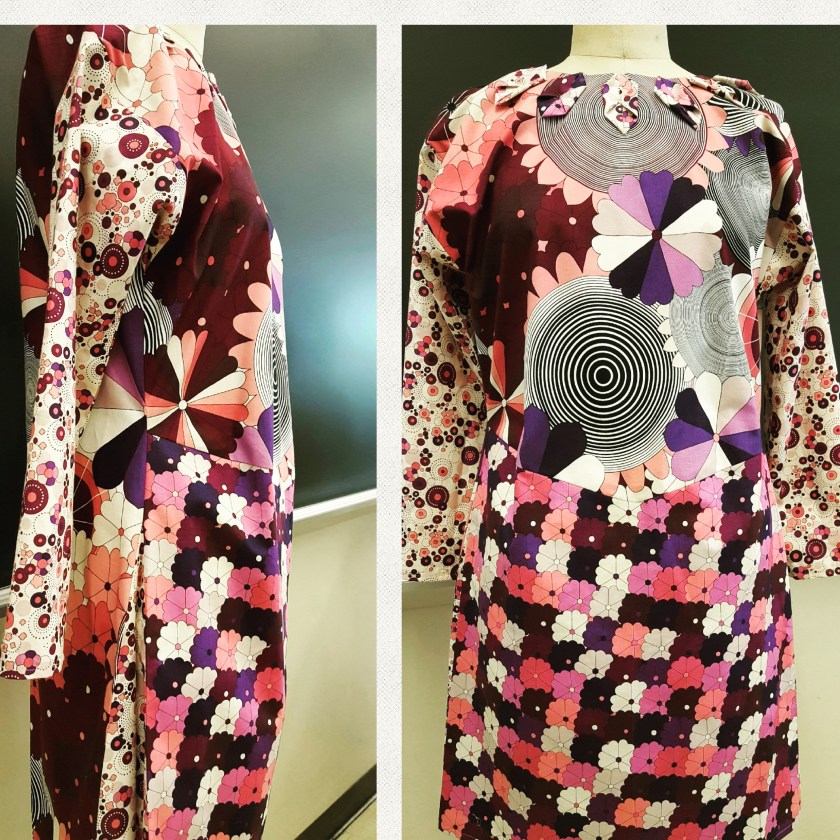
My design adopts and adapts the loose fit of the kimono by incorporating the dropped armhole along with the chemise silhouette. Godets are added on the side seams to add fullness imitating fabric layers of the kimono. Fabric folded origami sculptural motifs are added to the surface of the design.
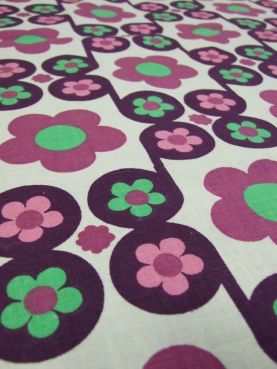
The dropped armhole reflects fashion of the 1940’s along with fabric choices reminiscent of the Mod print fabrics of the 1960’s. Through the use of dart manipulation, my design expresses the influence the Japanese culture and the 1960’s played in my life.
This summer, after the removal of a vinyl pool and redwood deck that pretty much encompassed my backyard for the last 23 years, I’ve been able to plant flowers and vegetables. I purchased tomato plants and bell pepper plants from the nursery, and the zucchini, sunflowers and zinnias were planted by seed. It’s been a challenge keeping the birds, squirrels, raccoons and skunks from either eating the seeds or digging the plants up looking for grubs. As of today, I’ve been quite successful in my quest…
ZinniasZinnia and Butterfly
I enjoy the process of regeneration beginning with the planting, stages of growth and the blooming of nature. I try to focus on flowers that attract birds, bees and butterflies.
Orange Bell Pepper
With all the physical work that goes along with planting and maintaining a garden, I decided to reap the benefits by reading a book surrounded by the ever-changing daily beauty of my garden.
Recently, in a knitting class at A Verb for Keeping Warm in Oakland, CA I overheard a conversation about slow fashion in comparison to cheap fashion. A few weeks ago, I came across a blog post discussing a book written by Elizabeth L. Cline, entitled “Over-Dressed The Shockingly High Cost of Cheap Fashion.”
Elizabeth L. Cline
I immediately ordered the book online because I wanted to know what was going on. So far, I’ve read the first three chapters where Cline discusses the effects of global trade agreements on the garment industry beginning in the 1990s. In today’s world it’s chic, practical and democratic to buy cheap fashion. Cheap fashion fashionistas post their “shopping hauls” on YouTube and have thousands of followers. It’s a quantity versus quality culture…a garment expected to only last a couple of times through the wash becomes “disposable.” Cline mentions, “The wastefulness encouraged by buying cheap and chasing trends is obvious, but the hidden costs are even more galling. Disposable clothing is damaging the environment, the economy, and even our souls.”
I respect Elizabeth Cline’s non-judgmental discussion on the attraction of cheap fashion and its consumer, and she even admits to owning 354 pieces of cheap fashion clothing. After publishing the book in 2012, Cline owned 90 pieces of clothing.
As I progress through the book, I’m reminded why I began to sew again. I grew impatient with the lack of quality fabric, zippers and buttons along with shoddy garment construction used in ready to wear garments. At the time, I became increasingly aware of the relationship between ethical fashion, and the culture of “slow fashion” (which refers to sewing your own clothes with sustainable fabrics like wool and cotton).
I look forward to the reading the remaining chapters of this interesting book, while I enjoy communing with the many bees, butterflies and hummingbirds that visit my backyard.
Photo credit: Mary Lou FallPhoto credit: Mary Lou FallPhoto credit: Mary Lou Fall
On one of my recent visits to Britex in San Francisco, I learned the store was phasing out sewing patterns from the “traditional” companies like Vogue for Indie and independent designers. I respect Britex’s attention to uniqueness and its historic reputation to stand apart from the rest, especially craft/fabric stores, but it’s sad to say good-bye.
I decided to simultaneously work with a Vogue pattern and a pattern designed by independent designer, Lois Ericson. The written instructions for the Vogue pattern are more detailed, while the Sew and Design Pattern (Lois Ericson) is open-ended for creativity. I believe prior sewing experience is necessary to work with any of her patterns. (Of course, there is a new generation of designers I’m looking forward to investigating, but not limited to are Colette Patterns https://www.colettepatterns.com/ and Victory Patterns https://www.victorypatterns.com/.)
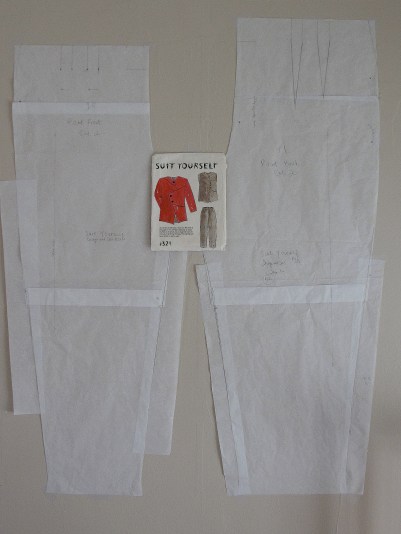
I traced the patterns onto medical pattern paper, and cut out a muslin of each pattern, and attended a garment construction class with Sally-Ann Flak. Sally-Ann fitted the patterns to my body, and I incorporated the changes to the pieces. Here is what I learned about my body in relation to these two patterns.
Vogue Pattern V7883
The pants pulled down in the back because my derriere sits low and I needed to add extra fullness. I added 1/2 inch 6 inches down from my waist by cutting and spreading the pattern piece. The front pants piece required no alterations. The top ended up being two sizes smaller than the pants.
Design and Sew #321 – Suit Yourself
As with the Vogue pattern, I traced and cut a muslin of the pattern. To begin with, the pants needed to be shortened 3 inches and the pant legs needed to be redrawn. The crotch length on the front needed to be shortened 2 inches. The waist on the front and back needed to be decreased by 3/8 inch. I needed to slash and decrease the hips by 1/2 inch. The back darts were a bit too long, so the adjustment didn’t require me to redraft the darts. The jacket is one size smaller than the pants, and needs to be fitted. I have a feeling the jacket needs to be one size smaller and 2 inches shorter.
Of course, the patterns are two different styles and probably is not a fair comparison, but I’m definitely developing a deeper understanding of pattern fit and alterations. My bod is not in proportion. The top of my body is two sizes smaller than the lower portion of my body with one hip higher than the other, and my hips tilt forward.
For a long time, I’ve wanted to delve into the world of fashion design, and I believe now is the right time. Staring in August, I plan on exploring the Fashion Design and Merchandising Department at Canada College in Redwood City, CA.
As the mercury rises, it’s time to pull out my summer clothes. Looking in my closet, I realize, “I don’t have anything to wear.” I use to spend more time at the shopping mall, but now I’m embracing “slow fashion for the home sewist.” For a definition and interesting article about slow fashion, read this article by Kate Fletcher. http://www.theecologist.org/green_green_living/clothing/269245/slow_fashion.html
Well, time to set up my sewing machine and re-discover the many hidden gems in my stash of fabric. I do recall purchasing a few yards of cotton canvas fabric designed by Yoko Saito a couple of years ago at, A Verb For Keeping Warm in Oakland, CA. After purchasing the fabric, I discovered Ms. Saito is an internationally known quilt artist, and I also own one of her books. What a coincidence!
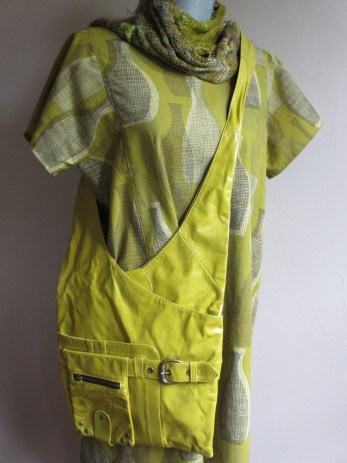
Across the store, a bolt of fabric caught my eye. I noticed the fabric because of the color, but most of all the modern look with a vintage appeal of vases on fabric and the simple intersection of lines drawn on the vases. The sales person mentioned, “perhaps the fabric would suit kitchen curtains.” I had another idea…
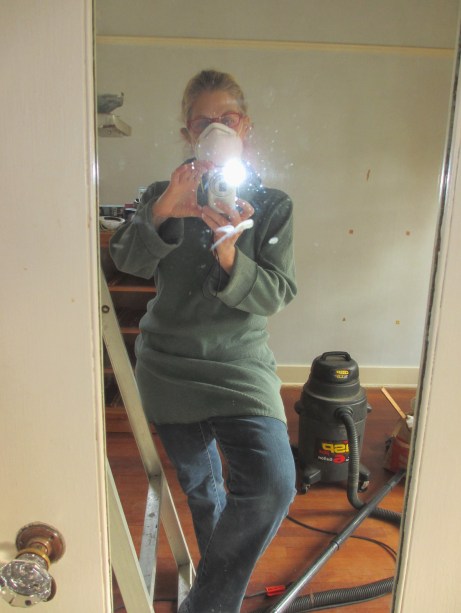
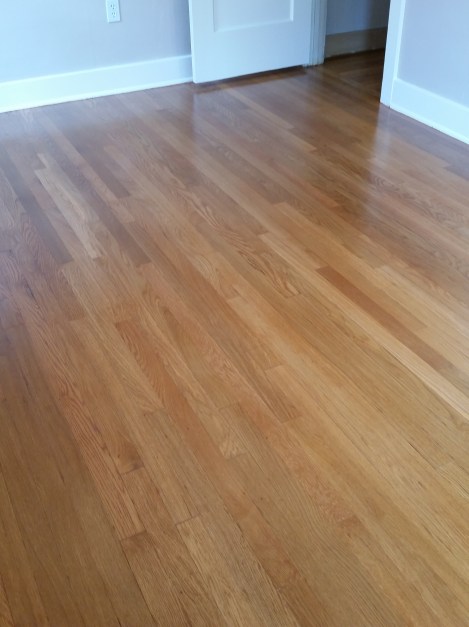
It’s been a few days since my last post, but for the last nine months, in between my sewing and knitting projects, I’ve been involved in a DIY project. I decided to convert our spare bedroom into my studio space. I pulled up old carpet, filled plaster cracks, sanded molding and painted. The floors also needed to be professionally refinished.
It’s amazing what a fresh coat of paint and determination can accomplish.
Newly refinished floors.
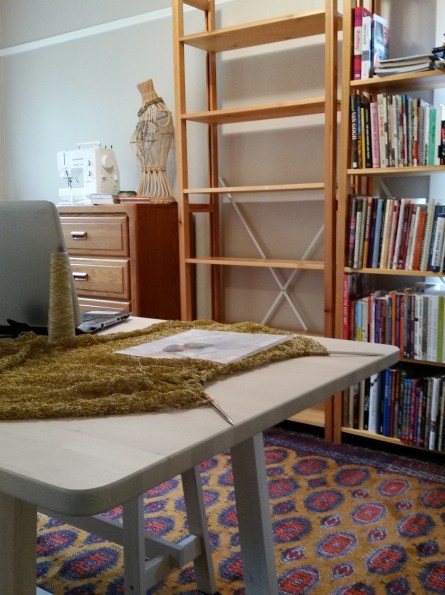
My Studio
Deciding to convert our spare bedroom was not an easy decision, but after being vacant for five years, I decided it was time to create a space for me. A positive enriching environment filled with my favorite things…yarn, books, fabric and ideas.
Recently, I took the plunge and purchased a new Baby Lock Ovation serger. The Baby Lock Ovation has an exclusive “Thread Delivery System” which eliminates the daunting task of manually threading the upper and lower loopers and eliminates the inconvenience of tension adjustments.
For the last thirty plus years, I’ve been using a Bernette for Bernina Funlock. Over the years, I’ve grown quite attached to my first serger because together we have enjoyed the pleasure of constructing Halloween and dance recital costumes along with child and adult clothes. But, I’ve decided it’s time to charge ahead, in order to create and construct new garments using current technology.
At first, I was intimidated by the size of the Ovation. I removed it from the box, sat it on the dining room table and just stared at it. “What was I thinking?” I decided to take a Sewing With Knits class at Eddie’s Quilting Bee with Sally-Ann Flak.
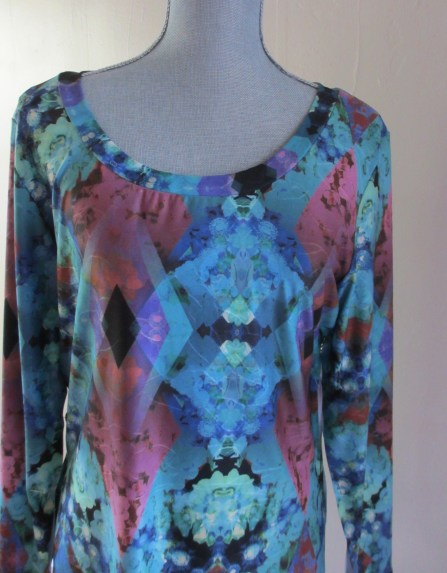
Kwik Sew K3766
Using a Nicole Miller graphic print fabric, I constructed the complete top with my Baby Lock Ovation serger. The fit is amazing and the fabric is beautiful.
Growing up wearing clothes designed for the chubby girl was so heart wrenching. It was difficult to find clothes that didn’t make me look matronly. I loved school, but I despised shopping for new school clothes each year. My mother would take my sister and I clothes shopping together (who was by the way, THIN). While trying on my chubbie size and her 6X (for thin little girls) in the same dressing room, I was reminded of the comparison. Of course, I didn’t resent my sister, I envied her.
I’ve kept these feelings hidden throughout the years, until now…
The NYU Costume Studies M.A. Program proudly presents their annual exhibition, BeyondMeasure: – Fashion and the Plus Size* Woman, beginning January 13-February 3, 2016. “The fashion industry as played an undeniable role in enabling the stigmatization of larger women’s bodies.” http://beyondmeasurenyu.com/
You’ll notice the model was not a “chubbie” girl. Though the merger between academia and the museum is interesting, will this have a “real” effect on our overall culture?
This week I needed to get a way for a day. I decided to return to the stacks at the University of California, Berkeley’s Anthropology library. During my stay as a student, I spent many hours focusing on Art History, with little regard or time for anything else. Now I have the time to explore other disciplines. I was looking forward to picking up a book I had on hold at Doe Library, Decorative Patterns Of The Ancient World, by Flinders Petrie. On my way, I captured a picture of the infamous Campanile.
Photo credit: Mary Lou Fall
Such a relief to relax and take in the atmosphere without worrying about the next paper or test. I headed over to the Anthropology library and ventured into the world of prehistoric textiles. Three books, Women’s Work: The First 20,000 years, Making Textiles In Pre-Roman And Roman Times, and Textile Production In Pre-Roman Italy, I was excited to discover because they support my area of interest.
My interest in textile arts began at the age of eight. Through the guidance of a 4-H leader, I walked the runway in my first sewn dress. I continued to sew through the years and decided to purchase my first weaving loom. Toting my infant daughter on my hip, I warped my loom for the first time. From weaving, I moved on to knitting, felting and dyeing yarn. Throughout the many years of developing my expertise in the textile arts, I didn’t give much thought to the people, places and identities of the individuals that came before me, until now.
On my way across campus to the parking garage, I captured a few more pictures.
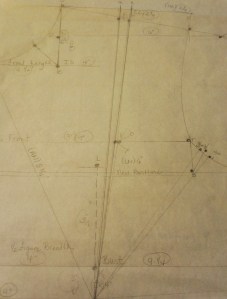
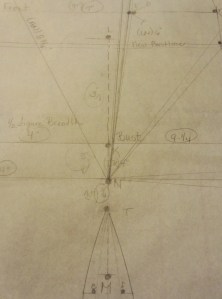
After completing pattern drafting for Skirts, I decided to move forward with Moulage. With pencil and eraser nearby, I began translating my measurements onto paper, the end result would be a “mold” of my body to assist in garment construction.
First, I needed to draft a Foundation Block front and back in order to draft a custom moulage of my upper torso. Once completed, I drafted a bodice sloper of my front and back, and mounted the two on oak tag.
The text book used for class, BuildingPatterns, The Architecture of Women’s Clothing, written by Suzy Ferrer can be a bit overwhelming given the amount of technical information. A semester of instruction would definitely explain, in detail, the technical aspects of this informative book.
Here is my moulage. A few minor adjustments to the shoulders and hips were made (as pinned in the photo.)
It was an intense experience, but also rewarding. I am proud of my accomplishment.























 The text book used for class, Building Patterns, The Architecture of Women’s Clothing, written by Suzy Ferrer can be a bit overwhelming given the amount of technical information. A semester of instruction would definitely explain, in detail, the technical aspects of this informative book.

 Sticks-a-GoGo
You must be logged in to post a comment.