I wish I lived in London…

I wish I lived in London…

I’ve just added Instagram to my blog, which chronicles my day-to-day adventures creating a narrative absent of words. I hope you enjoy viewing another side of my personality, as I chronicle my life through the lens of my cell phone.


As I delve deeper and deeper into the world of Fiber Arts, weaving has captured my attention. This is a great video about a man in England saving some of the old weaving machines to be reused.
via The Rabbit Hole — Knitting before Knitting was Cool

In an effort to satisfy my curiosity about geometric ornamentation, I decided to go on a self-directed journey of research. What I’ve uncovered so far, has expanded my worldview on the importance of weaving, and the significant role women played in the development of an economy. It’s no secret how I feel about the use of geometric ornamentation on textiles, especially the zigzag or chevron. According to Bernhard Schweitzer, “Geometric patterns have, in fact, a large number of different sources. They began at about the end of the Early Stone Age.” Schweitzer also mentions, “It is not until the development of leather-work, weaving, and pottery in the Neolithic Age that the necessary preconditions are created for real geometric ornament to appear in certain places. Sometimes, it is the result simply of a playful instinct to “doodle” aroused by the shape of the object.”
Who knew weaving played such an important role in history? Perhaps I’ve taken my talent and passion for knitting, weaving and sewing for granted? I didn’t even know about the Spinning Aphrodite until I read, Women’s Work: The First 20,000 Years, written by Elizabeth Wayland Barber. Barber references original research by Elmer G. Suhr. The Spinning Aphrodite written by Suhr, explains the symbolical significance of the spinning process, its association with the goddess and why the connection between the two has not been recognized in the past.
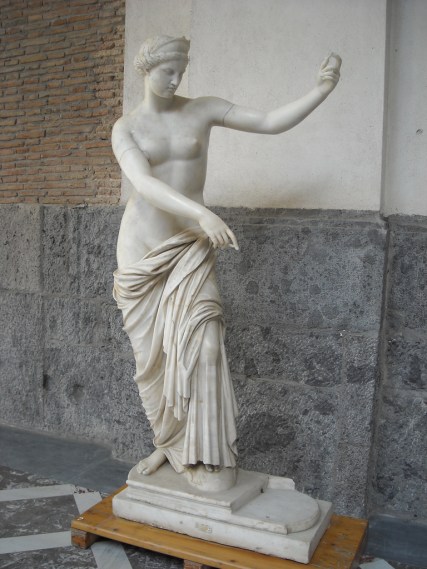
Pictured below is my desire to doodle with yarn creating the ancient zigzag pattern.

Chameleon Chevron Scarf knit with various sock weight self-stripping yarn in random order alternating colors every 2 to 4 rows, measures 7″ wide by 70″ long. I decided to knit a second scarf to be used as a lining, so there will be no wrong or right side. The two pieces were stitched together using my sewing machine.
Here are some sample swatches of the zigzag/chevron geometric motif in mosaic knitting. I especially like mosaic knitting with slip stitches because the knitter works one color at a time. Also, the back of the knitting remains neat and tidy. The shadow patterns shown below are from, Mosaic Knitting by Barbara G. Walker. Shadow mosaic designs look the same upside down and right side up, and will “shadow” each other.

The above pattern is Shadow 47 using Method III, Multi-color Reversal using a combination of five different colors.

Shadow 47 Method I – Color Reversal, the top two bands form zigzag/chevrons. The bottom two bands are Method II – Pattern Reversal changes the whole design of the shadow mosaic from zigzag/chevrons to diamonds. In Mosaic Knitting, a photograph is shown for Method I – Color Reversal, but Method II – Pattern Reversal is not shown creating a totally different looking design of surprise.
I look forward to uncovering more discoveries in the textile arts on my self-directed research into the history of “women’s work,” bringing a modern day twist using ancient patterns.

The February 14, 2016 issue of the New York Times Style Magazine printed two very interesting articles, The New Power Dressing by Sarah Nicole Prickett and Under Appreciated photographed by Charlotte Wales and styled by Elodie David-Touboul. Both articles visually appropriate patterns/motifs and dance from ancient history, in order to encode a message.
The looks are from the Spring Collections for 2016 from Gucci, Celine and Versace. I am intrigued with the skirt from Gucci.
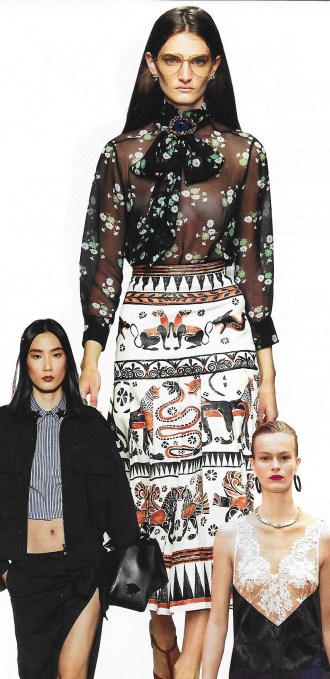
Immediately, the skirt reminds me of an Etruscan Pontic amphora vase painted by the Paris Painter of four women. The waistband of smaller narrow triangles separated by a formal border delineates a register of a combination of marine life (snakes, frogs, and fish (egg layers all are also thought to bring wealth and fertility to the household, in various parts of Europe), rosettes and a heraldic pose of perhaps lions/lionesses. The Lion Gate, a relief sculpture of two lionesses or lions in a heraldic pose symbolizing guardians of the gate were discovered at the main entrance of the Bronze Age citadel of Mycenae in southern Greece. The middle register enclosed by a border of palmettos supported by spirals and a border of small triangles contains fantastical creatures and a serpent/snake and the background is ornamented with rosettes of various sizes. The bottom register depicts what could be a collection of two-headed griffins. Cerberus, the two-headed dog guarded the entrance to Hades while griffins guarded treasure and priceless possessions. The larger narrow triangles create the hem of the skirt. The woman that wears this skirt possesses divine power, guards her treasure and and decides her own destiny. Fertility, prosperity and protection. The fabric design of the skirt reflects ancient costume too.

Two photographs taken by Charlotte Wales and styled by Elodie David-Touboul also expertly adopt and adapt ancient celebration/dance for modern day fashion. What do you think?


“The New Power Dressing” coined by Prickett, “Breaks with conformity and “unisex” no longer means “mannish” but rather glamorously bisexual in a fin-de-siecle way.” I argue, cloth conveniently expresses a silent social message of female individuality, culture and status.
Know first who you are, then deck yourself out accordingly. – Epictetus,Discourses, 3.1

I finally finished knitting my first cape. It has been a major time commitment, but my upcoming trip to SF was my motivation. I wanted to finish the cape to show it off, while walking the streets of SF next week. Lately, the temperatures in Northern California have been unseasonably warm for this time of year. I hope the fog rolls in next week and I can take my cape on an adventure.

The Cape Coat designed by Debbie Bliss published in The Big Easy, appears on pages 21 and 22. The knitting pattern calls for Debbie Bliss Luxury Tweed Chunky, but I decided to knit with Noro Kama 26% wool, 25%silk, 25% alpaca, 12% kid mohair and 12% angora. I also shortened the length measurement by 1-1/2 inches.
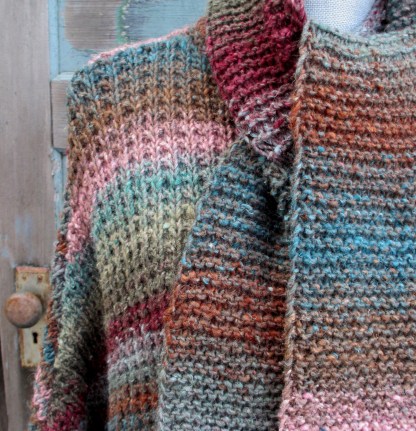
A garter stitch scarf accents The Cape Coat stitch pattern nicely.
Psst…I neglected to mention, last week I decided to take a daycation at Sea Cliff Beach. The coast has taken a pounding the last month. Here are some photos of my day.

An artist painting surrounded by trees, sand sculptures and driftwood.

The remains of the SS Palo Alto, commonly known as the cement boat.

A sand sculpture.

Growing up wearing clothes designed for the chubby girl was so heart wrenching. It was difficult to find clothes that didn’t make me look matronly. I loved school, but I despised shopping for new school clothes each year. My mother would take my sister and I clothes shopping together (who was by the way, THIN). While trying on my chubbie size and her 6X (for thin little girls) in the same dressing room, I was reminded of the comparison. Of course, I didn’t resent my sister, I envied her.

I’ve kept these feelings hidden throughout the years, until now…
The NYU Costume Studies M.A. Program proudly presents their annual exhibition, Beyond Measure: – Fashion and the Plus Size* Woman, beginning January 13-February 3, 2016. “The fashion industry as played an undeniable role in enabling the stigmatization of larger women’s bodies.” http://beyondmeasurenyu.com/

4088 Chubbie Pattern, Printed 1961 Simplicity Pattern Company, Inc., (founded 1927)
You’ll notice the model was not a “chubbie” girl. Though the merger between academia and the museum is interesting, will this have a “real” effect on our overall culture?

An article written by Karin Schott in the February 1, 2016 Huffington Post, The Ex-Husband Sweater, http://www.huffingtonpost.com/karin-schott/the-exhusband-sweater_b_9132208.html speaks to the emotional investment a knitter has to her work. How many of you can understand her thoughts expressed in the article? I certainly do.
https://en.wikipedia.org/wiki/Sweater_curse


This week I needed to get a way for a day. I decided to return to the stacks at the University of California, Berkeley’s Anthropology library. During my stay as a student, I spent many hours focusing on Art History, with little regard or time for anything else. Now I have the time to explore other disciplines. I was looking forward to picking up a book I had on hold at Doe Library, Decorative Patterns Of The Ancient World, by Flinders Petrie. On my way, I captured a picture of the infamous Campanile.

Photo credit: Mary Lou Fall
Such a relief to relax and take in the atmosphere without worrying about the next paper or test. I headed over to the Anthropology library and ventured into the world of prehistoric textiles. Three books, Women’s Work: The First 20,000 years, Making Textiles In Pre-Roman And Roman Times, and Textile Production In Pre-Roman Italy, I was excited to discover because they support my area of interest.
My interest in textile arts began at the age of eight. Through the guidance of a 4-H leader, I walked the runway in my first sewn dress. I continued to sew through the years and decided to purchase my first weaving loom. Toting my infant daughter on my hip, I warped my loom for the first time. From weaving, I moved on to knitting, felting and dyeing yarn. Throughout the many years of developing my expertise in the textile arts, I didn’t give much thought to the people, places and identities of the individuals that came before me, until now.
On my way across campus to the parking garage, I captured a few more pictures.

Photo credit: Mary Lou Fall

Photo credit: Mary Lou Fall

Photo credit: Mary Lou Fall

My eye is attracted to Early Geometric Period ornamentation. The basic elements of the dot, the straight line and the angled line are the elements of this style. The angled line motif makes up the zigzag, which is my favorite motif. The regularity of the chevron/zigzag ornamental design produces a repeat I find appealing.
According to Bernhard Schweitzer,
“The Geometric style is without doubt entirely a pottery style, as it has come down to us. But a series of phenomena suggest that it developed alongside a lost textile art and that this may even have been the origin of Geometric art before 900 BC.”
(Geometric Greek Art, Bernhard Schweitzer, published as Die geometrische Kunst Griechenlands, 1969. Translation 1971 by Phaidon Press Limited p. 30)
Wow! A “lost textile art” and a pottery style developing side-by-side may have been the origin of Geometric art before 900 BC. Perhaps pots were decorated with ornamental motifs adopted from textiles and adapted for the structure of the vessel.
After completing the Zick Zack Scarf designed by Christy Hamm http://www.ravelry.com/patterns/library/zickzack-scarf I’ve been curious about the effects of combining a zigzag/chevron stitch and self-patterning sock yarn. I began with a collection of five different colors labeling them A-E. I knit a specific number of rows per color.

After seven repeats of the pattern, I reversed the order of the five colors which changed the assigned row repeat too.

I eliminated three colors, and knit alternating every two rows.

I’m pleased with the exploration so far.

 Sticks-a-GoGo
You must be logged in to post a comment.