Woven Mesh Cowl Redux

Originally, I designed the Woven Mesh Cowl with a yarn that is no longer available. Previously, I didn’t have control over what I designed with, but this time I selected from my own stash of Habu textiles and vintage rayon yarn from The Great Adirondack Yarn Co.  How liberating!  I improved the design by adding a K2 P2 rib which eliminates the rolled edge of stockinette stitch.  I combined  different colors of Habu wrapped merino for the stitch pattern, used wrapped silk for the rib stitch and each segment of the pattern stitch is separated by a touch of copper-colored metallic lame rayon yarn.

The pattern stitch knit in the round:

Rnd 1:  Knit

Rnd 2: *Purl 1, Slip 1 wyif* repeat across round

Rnd 3: Knit

Rnd 4: *Slip 1 wyif, Purl 1* repeat across round

Gauge:  Approximately 4.5 sts/5 sts per inch

CO 223 stitches using a Size 7 needle. Join being careful not to twist stitches.  I cast on an extra stitch for joining.  If using another method of joining, use an even amount of stitches.  I began with 8 rounds of rib followed by the pattern stitch.  Separate each segment of pattern stitch with rounds of stockinette stitch.   When cowl has reached desired width, end with 8 rounds of rib.

Bind off loosely.

Woven Mesh Cowl Redux #3

Woven Mesh Cowl Redux_1_1

Baby Color Block Sweater

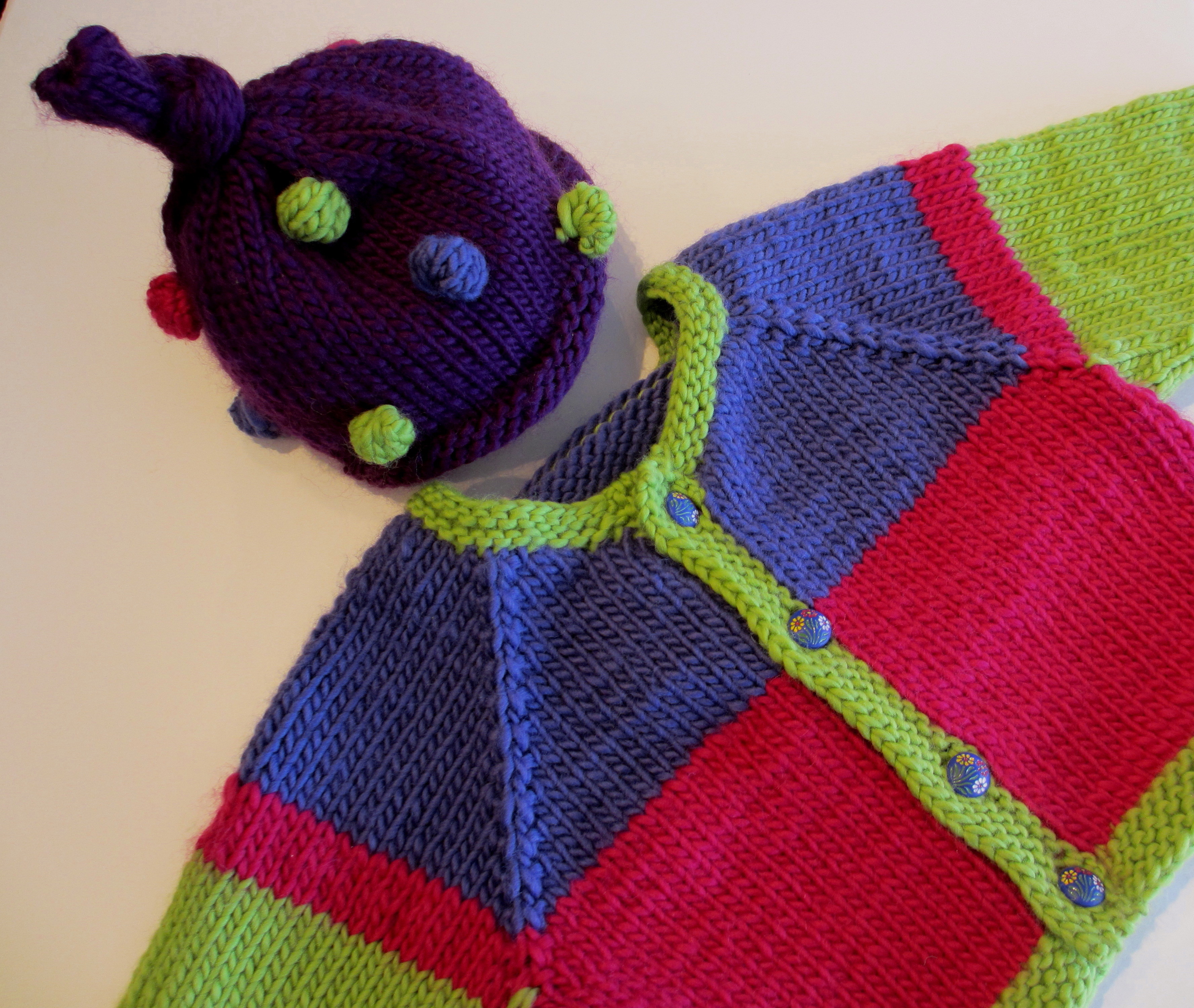
How do you knit cute?  Here’s the pattern for the baby color block sweater.
Bobbles and Top Knot Ensemble

Baby Color Block Sweater

Designed by Mary Lou Fall

Materials:

(5) Hanks Jil Eaton MinnowMerino, (100% extra fine superwash merino, 77 yds) (2) hanks green, (2) hanks pink, and (1) hank blue/purple

Circular Sizes 6 and 8

Double point needles Sizes 6 and 8

4 to 5 buttons, ¾ to 1 in.

Stitch markers

Gauge:

16 sts to 4 in. square over St st using size 8 needles, or size to obtain gauge.

Abbreviations

Kf&b – knit into the front and back of the st

ssk – slip one stitch as if to knit, slip the next stitch as if to purl, slip the tip of the left needle into the fronts of both stitches and knit them.

K2tog – knit two stitches together

Technique for Stitches

Stockinette st – When knitting in the round, knit every row.

Garter st – When knitting in the round, purl the first round, knit the second round.  Two rounds make 1 ridge.

Directions

The color block sweater is knitted in one piece, starting at the neck edge.  Directions are written for size 6 months with changes for larger size (up to 1 year) in parentheses.

Beginning at neck edge with blue/purple yarn and larger size 24 in. needle, cast on 2 sts, place marker, cast on 10 (11) sts, place marker, cast on 16 (17) sts, place marker, cast on 10 (11) sts, place marker, cast on 2 sts.  40 (43) sts.

Row 1:  Kf&b (knit into the front and back of the first st (first increase made) *inc, slip marker, inc k to within 1 st of next marker* rep at each marker to last st, inc. (10 increases)

Row 2:  Purl

Row 3:  Inc, *k to within 1 st of next marker, inc, slip marker, inc*, rep at each marker, k to last st, inc.

Work rows 2 and 3 until there are 22 (23) sts between the back markers.  At the end of the last increase row, cast on to the right tip of the needle 3 sts.

Purl the next row and at the end, cast on to the right tip of the needle 3 sts as before.

Row 1:  On the next row, *knit to within 1 st marker, inc, inc*, rep at each marker, k to end of row.

Row 2:  P

Continue to work the last 2 rows, and change to pink yarn when you have 36 (41) sts between the back markers. Increase as established until there are 40 (45) sts between the back markers, ending after a p row.

Divide for Sleeves

Knit to first marker and remove, k1.  Slip all the sts between here and the next marker on to a stitch holder for the left sleeve.  Cast onto the right tip of the needle 5 sts and join to the back sts.  Knit across the back sts to the next marker, k1, slip all the sts between here and the next marker onto a stitch holder for the right sleeve.  Cast on 5 sts as before and join to front sts.  Knit to the end of the row.

Body

Work in stockinette st until work measures 9-1/2 (10-1/2) inches measuring from the top of the shoulder.  Change to green and using smaller 24 in. circular needle, work ¾ “of garter stitch.  Bind off loosely.

Neckband

Right front (as worn):  Join green yarn with right side of work facing you using smaller circular needle, pick up 8 sts across front, 10 (11) across top of sleeve, 16 (17) sts across back neck, 10 (11) across top of other sleeve and 8 sts across other front.  Work 2 ridges of garter stitch.  Bind off loosely.

Sleeves

Slip the sleeve sts off stitch holders onto 2 of the larger size double point needles.  With right side of work facing you, using a third double point needle, join green yarn to right edge of armhole and pick up 7 sts across the armhole, placing a marker after three.  This is the beginning of the round.

Rnd 1:  Knit one round

Distribute the sts evenly between the other needles.

Rnds 2-6:  Knit

Rnd 7:  K1, ssk, k to within 2 sts of marker, k2tog

Knit 4 more rounds for the smaller size OR knit 3 more rounds for the larger size.

Repeat Rnd 7

Work as established, decreasing every 5 (4) rounds, until sleeve measures 5-1/2” (6”) measured from armhole, or ¾” less than desired length.

Continue decrease round (Rnd 7) until 24 (26) sts remain.  Change to smaller double point needles and work 2 ridges of garter stitch.  Bind off loosely.

Front Bands

NOTE:  If the sweater is for a girl make the buttonholes on the right band.  For a boy, make the buttonholes on the left band.  Begin picking up stitches at the lower edge of right front with knit side of work facing you for the right band.  For the left band, begin picking up at the neck edge of the left front with the knit side of work facing you.

With knit side of the work facing you, pick up 3 sts for every 4 rows using the smaller circular needle and green yarn. Count these sts and make a note.  Mark buttonholes using safety pins, mark 2 sts for each buttonhole desired, spacing them evenly, about 2-1/2” apart with the first buttonhole 2 sts from the upper edge.

Buttonhole row: 

*Knit to marked sts, bind off* rep until all pinned sts are bound off, k to end of row.  On next row, *k to bound off sts, cast on 2 sts*, rep to end of band.  Knit every row until there are 2 garter st ridges.  Bind off loosely.

 **Every effort has been made to provide complete and accurate instructions.



Baby Top Knot and Bobbles Ensemble

Recently, I was asked to design a baby color block sweater and hat.  Knitting top down is a perfect opportunity to color block a sweater.  In addition, adding bobbles and a top knot to a baby hat provides just the right “cuteness.”

Baby Top Knot with Bobbles HatBobbles and Top Knot Ensemble

Designed by Mary Lou Fall

Materials:

Size 8 double point needles

One skein of Jill Eaton MinnowMerino (100% extra fine superwash merino, 77 yds)

Yarn stash for bobbles

Gauge:             4 sts/inch

Directions:

CO 60 sts and divide evenly between three double point needles.  Join, being careful not to twist sts.

Rnd 1: Purl

Rnd 2: Knit

Rnd 3: Purl

Rnd 4: Knit, increasing 4 sts evenly.   Knit until hat measures 3-3/4” from cast on edge.

Decreasing for the Crown:

Rnd 1: *K2, K2 tog, *repeat to end of round.

Rnds 2-5:        Knit

Rnd 6: Repeat Rnd 1 (decrease)

Rnds 7-9:        Knit

Rnd 10:           Repeat Rnd 1 (decrease)

Rnds 11-12:    Knit

Rnd 13:           *K2 tog, *repeat to end of round.

Knitting the Top Knot

Work remaining sts for approximately 3”; break yarn leaving a 4” tail.  Thread tail onto yarn needle, thread tail through remaining sts; pull snug and fasten off.  Tie the length of knitting into a knot.  Weave in ends.

Bobbles:

Cast on 1 st, leaving a 4” tail.  Knit into the front, back, front, back and front of cast on st.  (5 sts).

Row 2:            P5

Row 3:             K5

Repeat rows 2 and 3 twice. (4 rows)

Row 6:            Pass 2nd, 3rd, 4th and 5th sts, one at a time, over the first st.  Fasten off, leaving a 4” tail.  Fold bobble in half and pull both tails through to WS of hat and secure.

*Of course, any yarn that gives the correct gauge may be used.

**Every effort has been made to provide complete and accurate instructions.

Experiment or Mistake

Browsing through my pictures I discovered three experiments I never posted because I didn’t feel the outcome was worthy of a blog post.  Today, however, I find them quite interesting.  Should I consider these attempts an experiment or mistake?

Merriam-Webster Dictionary defines experiment as “A controlled procedure carried out to discover, or demonstrate something .” Mistake, “To blunder in the choice of.”

Felted Scarf and Wrap #1

Attempt #1: Originally, I did not find the colors appealing in the scarf I felted with the novelty yarn.  Now, I do.

Attempt #2: At the time, I thought the felted roving looked like a jumbled mess, but know the fiber looks like a spider web with a multitude of possibilities.

Last but not least, Attempt #3: The knitted block/rectangle was suppose to look like a log cabin quilt.  I wasn’t attracted to the outcome, but know I am pleased with the colors and texture created by the different yarn and color combinations.

I don’t consider these mistakes, they are experiments.  Perhaps our creative tastes evolve with time and experience.

Roving Spider WebLog Cabin

East Meets West

I recently discovered a free pattern offer by Noro called Reversible Scarf.  The pattern is also available in Noro’s Issue 4 Knitting Magazine.  The Reversible Scarf knit with two balls of Noro Obi on a US Size 10 circular needle in Garter Lace moves fast.  The Garter Lace pattern consists of a four round repeat.

Rnd 1 Knit

Rnd 2 Purl

Rnd 3 Knit

Rnd 4 *Yo, SKP, rep from* around

I decided to pair the Reversible Scarf with Stephen West’s Pogona from Book One.  Pogona is knit with Diakeito Dia Scene.  Diakeito is another yarn imported from Japan not easily found in Northern California.  I was first introduced to Diakeito at Stitches West by Andrea, the owner of Seaport Yarn  http://www.seaportyarn.com  located in New York’s financial district.

Much to my surprise on a recent visit to the East Bay (Berkeley, CA), I discovered a source for Diakeito.  The long color repeat of both yarns along with the textural qualities of Obi are visually interesting.

Diakeito Dia Scene CowlDiakeito and Noro Cowl

Happy New Year 2015

Recently, I received an email from WordPress detailing the stats this past year for my blog.  I originally decided to blog about my various creative endeavors with a pair of knitting needles and yarn in order to give the creative side of my life “purpose.”  Not to soon after I started blogging, I began teaching.  From teaching, I was asked to become a part of a design studio/yarn store in my local town.  So you see, stats were not on my radar.  I was hopeful that someone would find my posts interesting, but it did not matter.  I wanted a platform which would enable individuals to “see me” through my stitches.  I’ve tried to maintain a personal distance communicating only one stitch at a time because “words” are many times misinterpreted.

In retrospect, 2014 was a wonderful year.  My husband and I cruised up the Danube River for two weeks.  An experience I will forever hold close to my heart.  One morning, while cruising, I was awakened by a glow filtering through the drapes in our cabin.  I grabbed my camera and captured the sun coming up.  Perhaps we’ll see Istanbul or Paris this year.IMG_3076

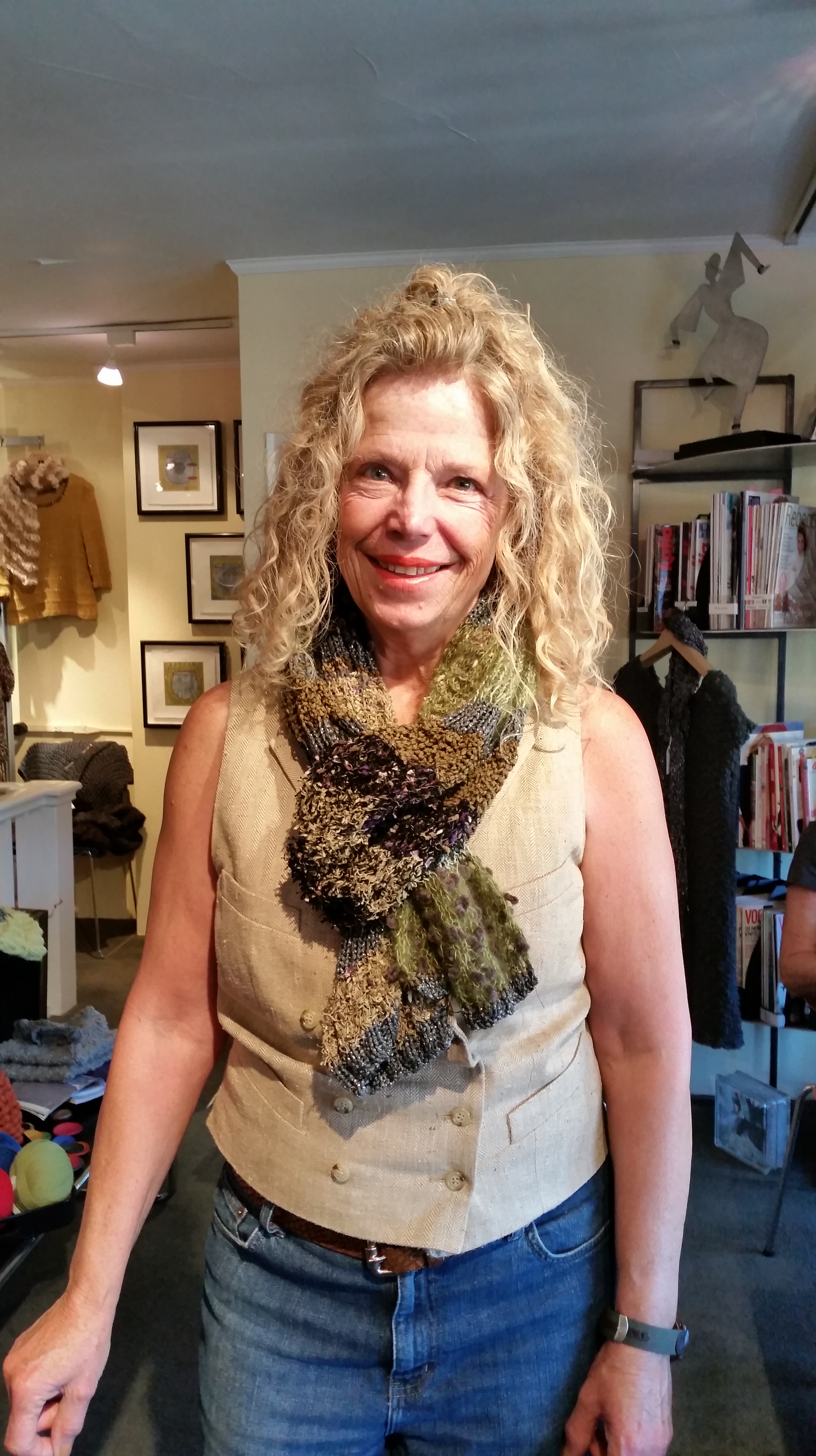
I ended the year by making a new acquaintance at Eddies’s Quilting Bee in Sunnyvale, CA.  Sally-Ann Flak, a talented artist, taught a class at The Bee.  I plan on taking a pattern drafting class this month and a Moulage class in February.  Check out a picture of me wearing a scarf and holding another on Eddie’s Quilting Bee Facebook page.  I was able to finish both scarves in Sally-Ann’s class.

To all sticks-a-gogo’s friends, Facebook friends, and my friends in the real world, Happy New Year!

Where There’s A Will

Last week, my niece Jessica wanted to crochet a scarf for her boyfriend’s mother.  She went to her stash and found the perfect yarn, but did not have a large enough hook to accommodate the gauge of the yarn.  How did she handle such a dilemma? She looked on YouTube to learn how to hand knit.   https://www.youtube.com/watch?v=oT3gdc44Lp8

I am amazed at her instant success.  Usually, it takes a crocheter practice getting comfortable using two needles after developing muscle memory holding a hook.

Jessica and Scarf (1)

Jessica has some tips of her own before embarking on hand knitting:  Use the restroom, have a cigarette and turn off your cell phone because you won’t be able to answer.

Fantastic job Jessica!

Who Needs Jewelry

This week while working (if you call surrounded by gorgeous yarn, patterns and buttons work), one of my students stopped by Very Knit Shop in Los Gatos, CA to model her completed scarf from class.  The focus of the class is to combine 20-30 different yarns, gauges and textures in order to create random blocks of pattern and color.

The gallery downstairs was having an artist’s reception and my student was attending, proudly wearing her scarf.

I’m always surprised when combining different yarns and ribbons with Loopy and Luscious by Natalie Wilson, another option for embellishment adding just the right amount of style and design.  For the pattern, checkout http://www.knitty.com/ISSUEwinter02/PATTloopy.html

Luscious and Loopy with oil painting

20141107_154113

No Preconceived Notions

As I munched on my traditional “toasted bagel on Sunday,” my husband passed the Sunday New York Times Style Magazine.” (A tradition we started together three and a half years ago.)  I guess it can be considered a tradition…Right?

Anyway, I came across an article, “Sign of the Times,” by Andrew O’Hagan discussing a writers need for solitude.  Many writers seek the solitude by hiding away in a luxurious hotel room.  Hagan shares a female friend’s ability for “negative capability.”  “Her innate talent for devoting herself, at times, to being something other than she is.”  I vaguely recall this philosophy associated with Keats and also while studying the aesthetics of modernism.

I find it interesting to consider this philosophy in relation to the “straight jacket of the color wheel.”  As a fiber artist, I’ve always found the rules of color theory  a bit chaotic to wrap my mind around…primary, secondary, tertiary, complementary and so on.  This brings to mind a class I recently attended  on color with Brandon Mably, from the Kaffe Fassett studio.  Yarn separated into lights and darks created a paintbox of fiber.  A palette of lights and darks, from which an arms length of five different colors were combined creating visual harmony.  One ball of light and another of dark were used to knit a chart of a poppy design.  When someone brought up the color wheel, Brandon replied, “throw the color wheel out the window.”  As evidenced by all our knitting, perhaps “negative capability” transcends the rules of color.

Color Workshop with Brandon MablyColor Workshop with Brandon Mably #3Color Workshop with Brandon Mably #2Color Workshop with Brandon Mably #5Color Workshop with Brandon Mably #6Color Workshop wit Brandon Mably #4I

There are many things in life I want to experience, and a color workshop with Brandon Mably is one of them.  I must admit, in all honesty, my love and admiration for Kaffe Fassett’s contribution to our world of color, knitting, quilting and decorating.  To my surprise, what a treat it was to be in the company of the color guys…Brandon and Kaffe.

Color Workshop with Brandon Mably #7