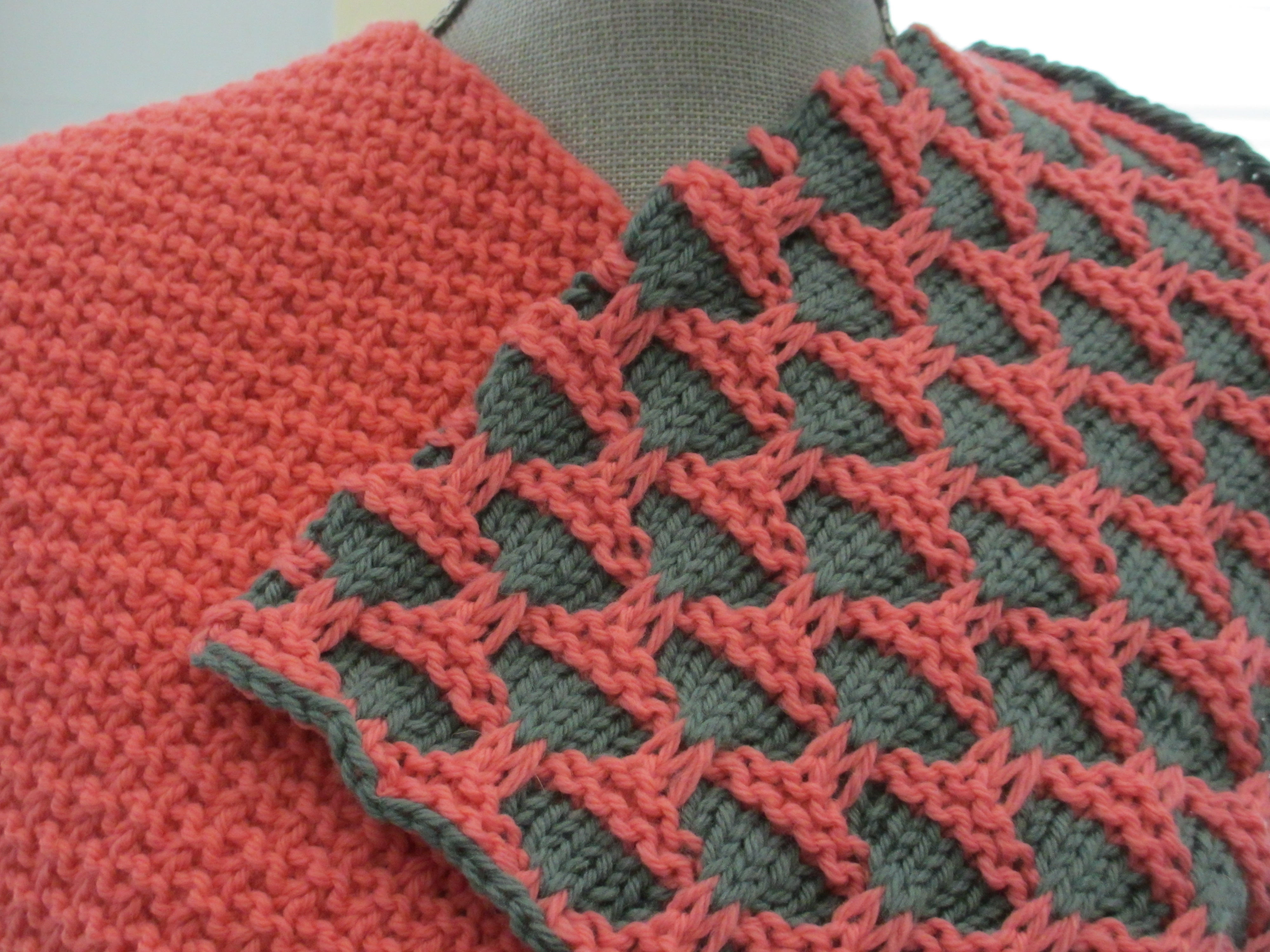
Hear ye, Hear ye all blog followers of knitorious…On October 7 and 14, join knitorious at the A Work of Heart craft lounge in San Jose, CA to partake in the festivities. From 9:30 am – 12:30 pm, tantalize your creative tastebuds learning the basic techniques of nuno felting. Just add a little water, soap and agitation and watch what happens. Check-out the class description at www.aworkofheart.com. Why not visit the craft lounge and get an up close and personal look at the scarf on display?
Anemone
After knitting a scarf in garter stitch with Kauni’s 140Effektgarn www.kauni.com, using a size 10-1/2 needle, I decided to add wooden beads of various sizes
for resists. After the fulling process, I was amazed at the sculptural piece of textile that emerged. Upon removing the wooden beads, random tops of the indivdual sculptures were cut-off. The frayed edges and openings add depth to the dimensionality of the felted textile. The randomness of resistance paired with the openness of the piece invites the admirer to look beneath the surface.
Manipulating the piece to visually examine the change of surface, triggered a memory. The act of looking, color and dimensionality brought back memories of exploring the coastline in Northern California with my daughter. While the opening and closing of sea anemones kept rhythm with the in and out of the tide, we climbed on the frayed edges of rocks searching for jellyfish, sand crabs and shells amongst beds of kelp.
Opposites Do Attract: Nuno Felt Meets Shibori
Many times, one idea leads to another idea, which opens up a plethora of possibilities. That’s what happened when I, knitorious, decided to combine the technique of nuno felting and the art of shibori. The manipulation of wool fibers with a woven structure along with resistance co-mingles two opposite actions.
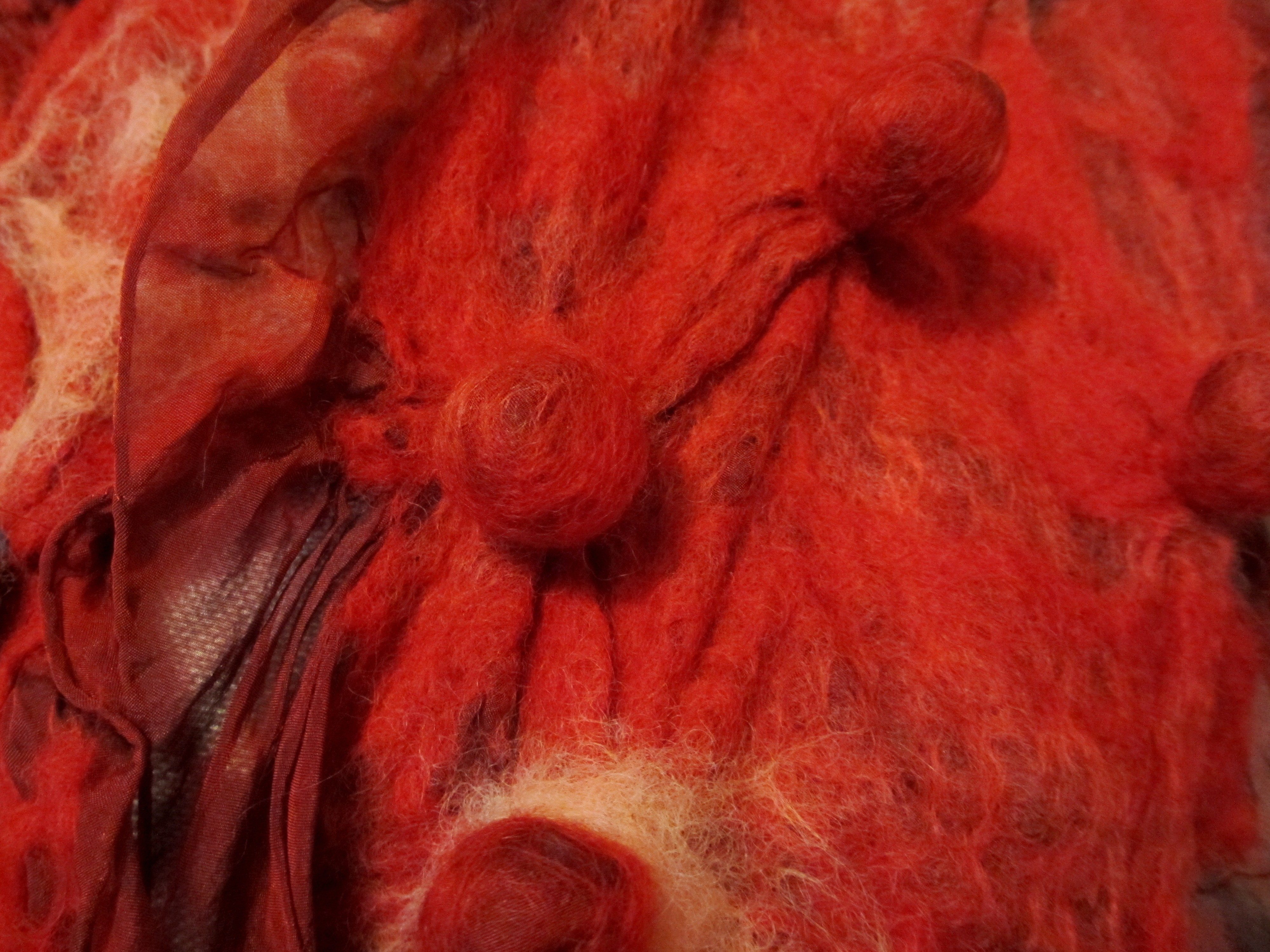
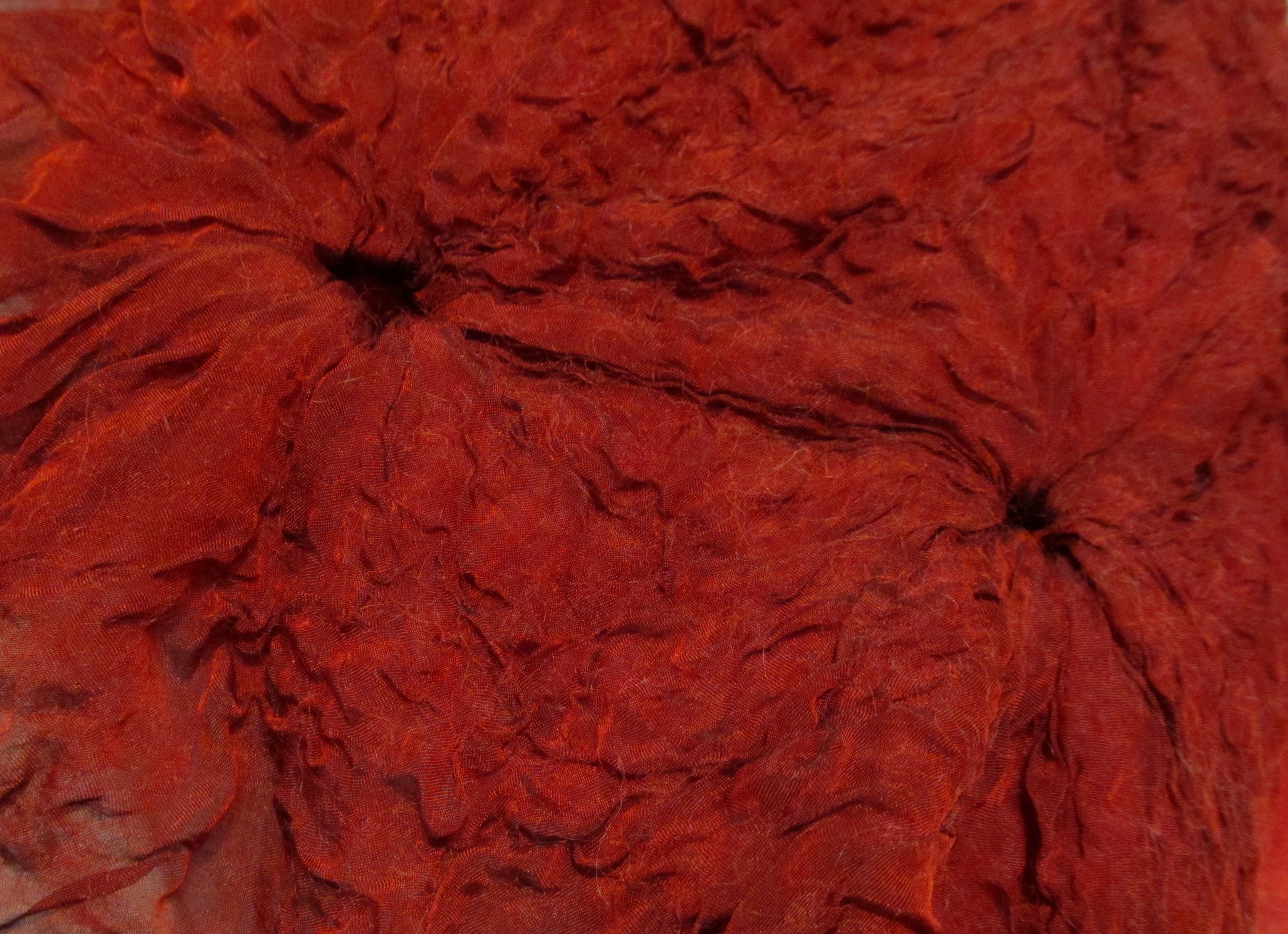
On the surface of a pre-dyed silk scarf, wool roving of two different colors were delicately placed, one layer horizontal and the other vertical. When the fulling process progressed to the point where the silk scarf began to pucker, wooden beads with a cocoon of yellow/orange-colored roving were each encased with a silicone band.
The action of resistance along with the manipulation of the wool fibers and the woven structure of silk metamorphose the silk scarf into an intriguing sculpture.
Shibori
Shibori is a Japanese term for several methods of dyeing cloth with a pattern by binding, stitching, folding, tucking, compressing it or capping. The manipulating of the cloth, resists the dye, which decorates the surface with pattern.
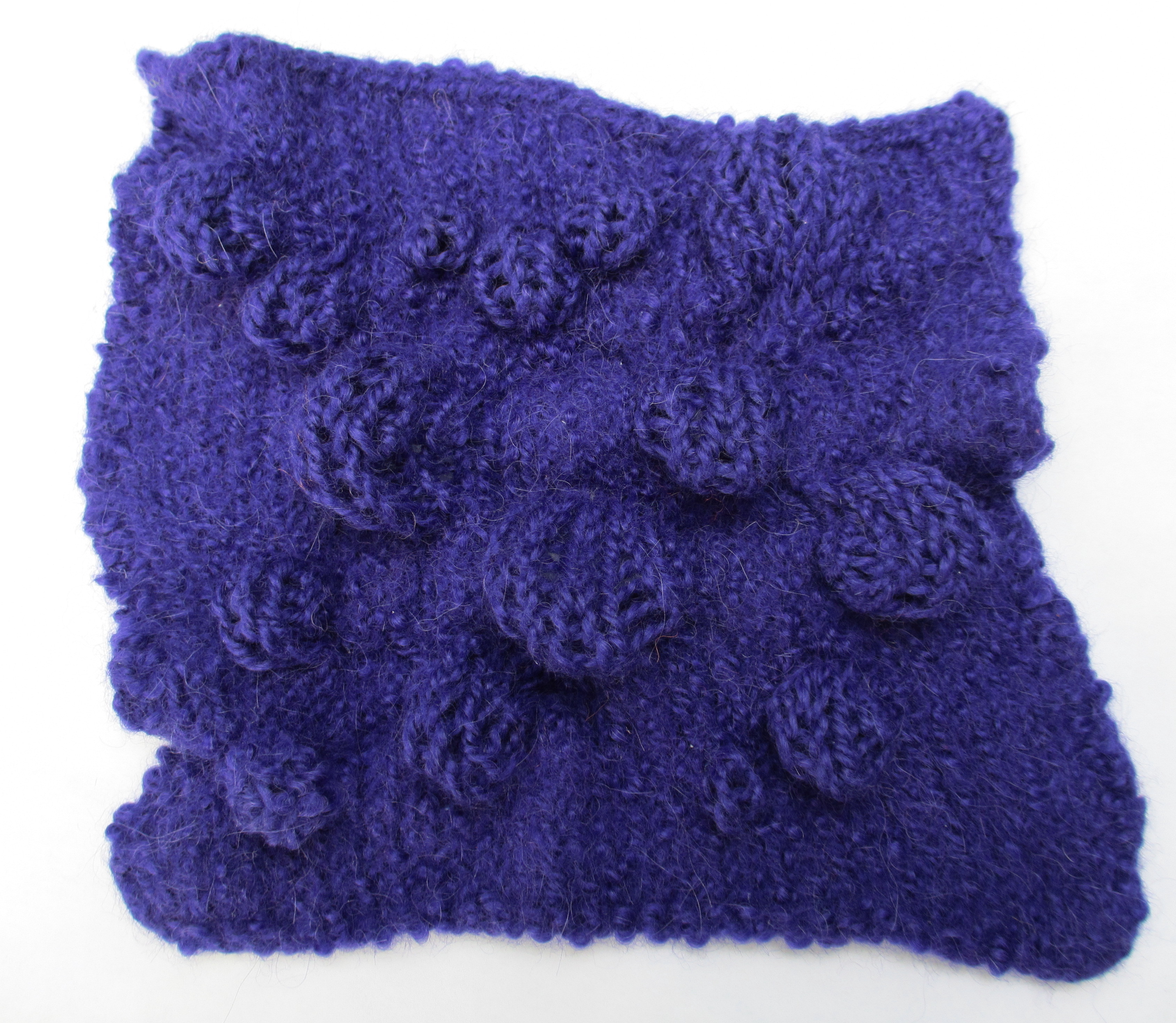
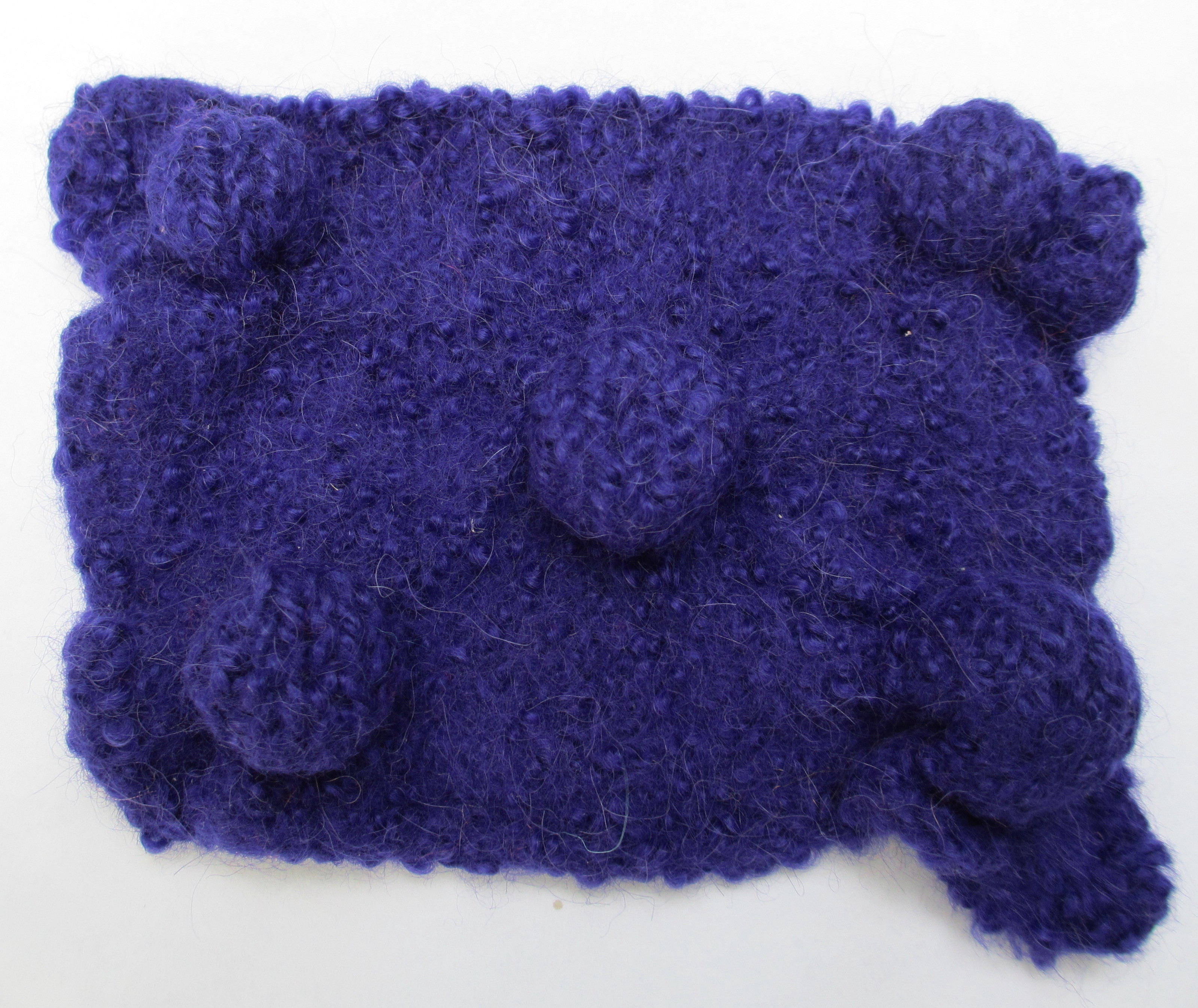
The same can be achieved during the fulling process in felting. Adding (wooden beads, buttons, nuts, etc., secured with silicone bands (similar to rubber bands) to the surface of knitting resists felting. Various sizes of wooden beads were used for the first blue/purple swatch. Plastic buttons were used for the second blue/purple swatch.
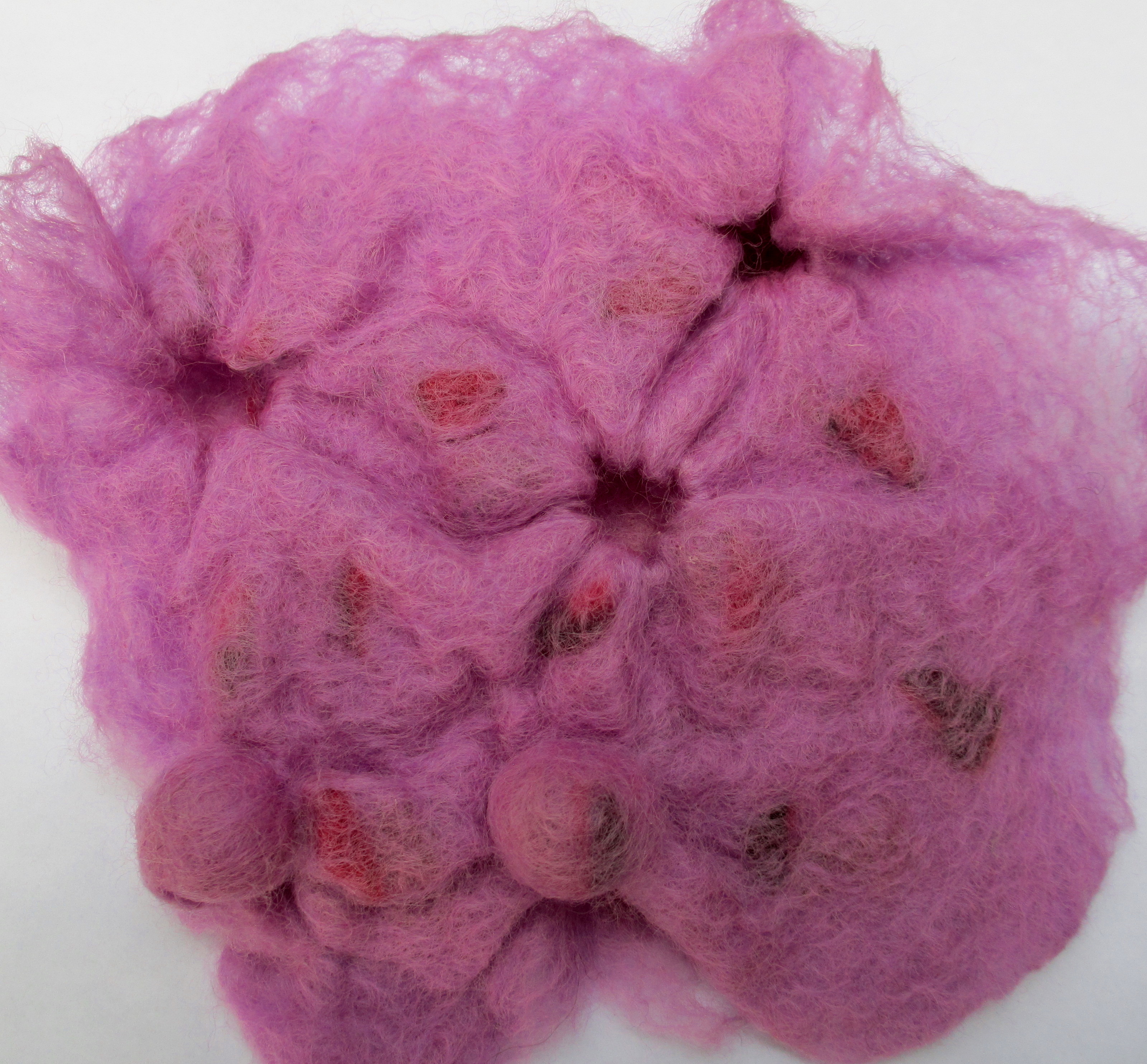
I decided to try adding resists while wet felting roving. The third swatch (pink/lavender) was manipulated with pre-felts and once the fibers began to full, I added wooden beads secured with silicone bands. I continued the process until the swatch felted to my desired likeness. After the swatch (pink/lavender) was completely dry, I cut the silicone bands and removed the wooden beads.
Pencil Roving and Recycled Sweater
What do pencil roving and a recycled wool sweater have in common? They both can be felted. Why not try felting both together?
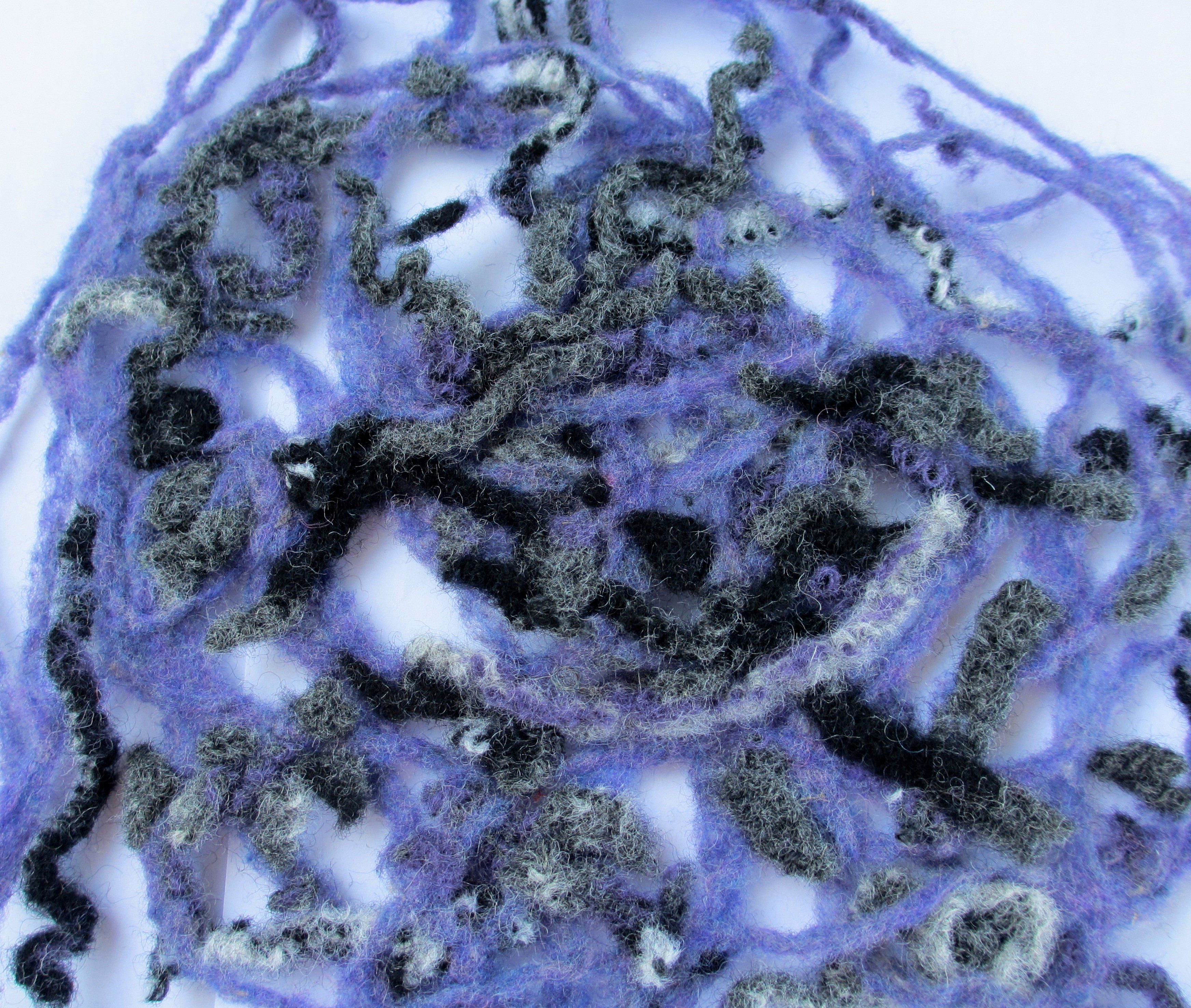
Lately, I’ve been gazing at my selection of Bulky 2 Strand Pencil Roving from Imperial Yarn alongside a pile of recycled sweaters neatly stacked in my craft space. I decided to season the pencil roving with cut-up felted sweater pieces. The stack of fiber resembled the appearance of cooked spaghetti. The felted pencil roving and sweater bits were transformed into a swatch of curiosity.
The felted sweater has been upcycled into a swatch of many possibilities. By the way, check out the wonderful selection of yarn, patterns and pencil roving at www.ImperialYarn.com.
Nuno Felt #2
Recently, while flipping through the pages of my many books on the subject of felting, I read instead of using silk for nuno felting, try cheesecloth. With a desire to experiment, I hiked to my local Sur La Table for a package of cheesecloth. The cheesecloth was hidden amongst the pots and pans and cost under five dollars. I decided to practice on a swatch instead of a whole project. Much to my surprise, a beautiful piece of fabric was created. A translucent and transparent surface was created due to the open weave structure of the cheesecloth and the behavior of the wool. The ability to allow light through the felting presented a beautiful sight.
The delicate quality achieved by the co-mingling of cheesecloth and wool roving reminds me of a cloudy day. I will definitely continue with this technique and felt a scarf. Perhaps I’ll try dyeing the cheesecloth when using a dyed wool roving.
Nuno Felt
Today in Northern California, the weather was perfect for experimenting with the Nuno Felting technique. Nuno Felt represents the co-mingling of wool fibers with the woven structure of silk. Synthetic fabrics also offer good support for this technique. Why not experiment with cheesecloth? Silk provides an intriguing background for this process because of its translucent appearance. Last year while cruising the marketplace at Stitches West, I spied pre-dyed silk scarves perfect for Nuno Felting. It was time to dust off the silk scarves and have some fun!
I filled a bucket with warm water, grabbed a bar of olive oil soap, and a roll of bubble wrap. The silk scarf was placed on a length of bubble wrap, wool roving was gently placed on top of the scarf, and I proceeded to saturate the scarf and wool roving with a solution of warm water and olive oil soap. I patiently agitated the surface with a piece of net between the surface of the scarf and my hands.
The manipulation of the surface created dimensionality to the scarf due to the felting of the wool roving. The silk scarf was transformed into a delicate piece
of sculpture.
Faux Enamel
Recently, I re-connected with polymer clay artist, Debbie Anderson. Debbie and I met in 1993, by chance through our shared interest in polymer clay. We were two of the original members of the South Bay Polymer Clay Guild. Debbie remained active in the guild, while I pursued my interest in Art History and knitting.
While listening to ADELE on my daily five mile hike, my mind began to wander…I wondered if the South Bay Polymer Clay Guild still existed. I decided to give Debbie a call and indeed the guild still exists. Much to my surprise, Debbie was teaching a class entitled, “Faux Enamel.”
On July 9, 2012, I returned to my polymer clay roots,
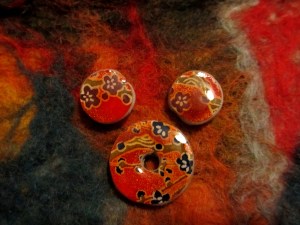
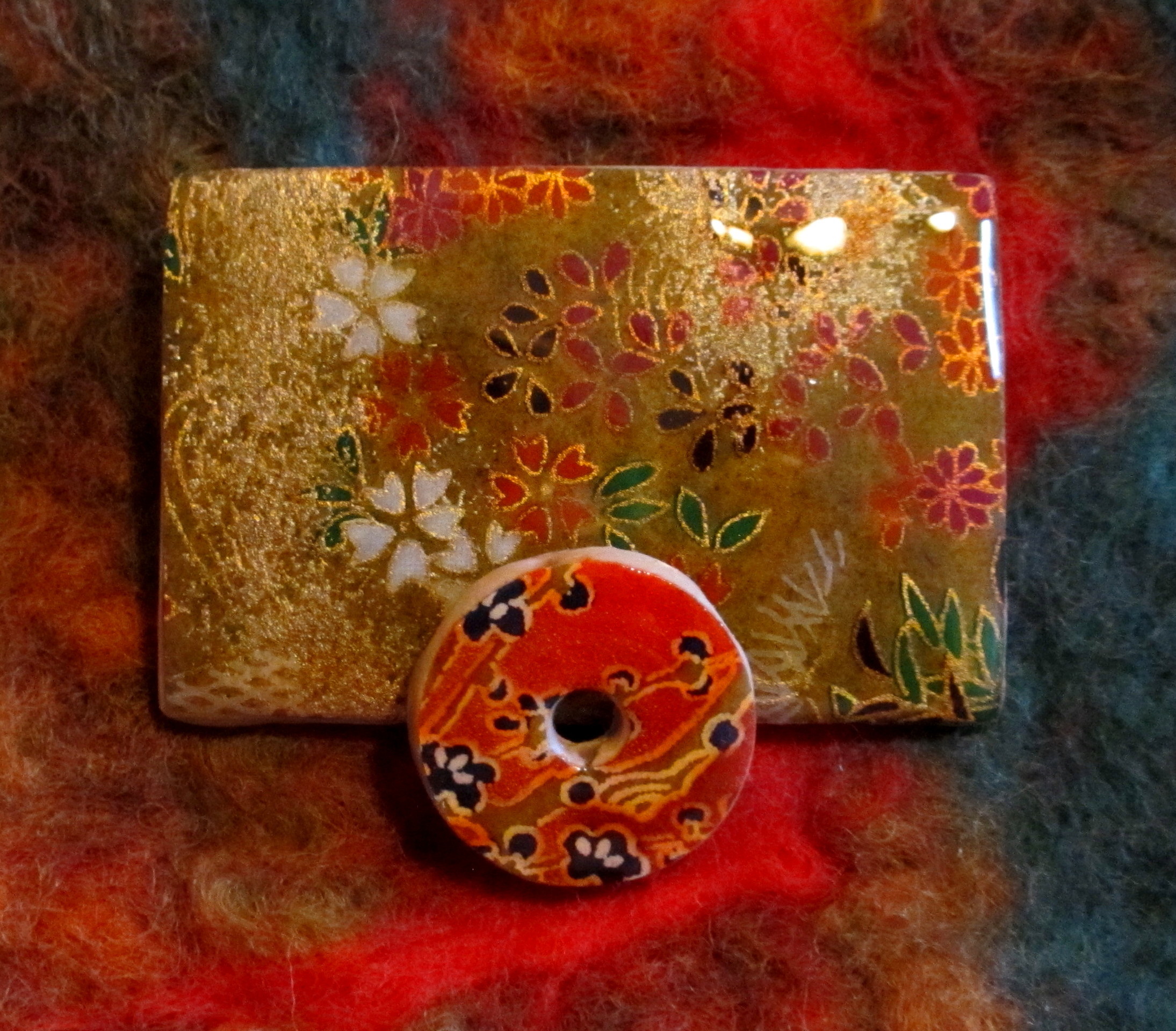
as I cranked my pasta machine for the first time in twelve years. Polymer clay sheets, Chiyogami Paper and resin were layered in a specific order, baked in a convection oven, which resulted in one-of-a-kind art pieces resembling the process of enameling.
The class was expertly taught, and I look forward to my next class with Debbie Anderson.
The pieces shown in these two photographs are backed by felt I created using the wet-felting technique.
Color, Pattern and Texture
Creating motifs knitting traditional Fair Isle or Intarsia are not of interest to me. Each time I crack the cover of Kaffee Fassett’s, kaffee Knits Again or Sasha Kagan’s, Country Inspiration, I marvel at pictoral images translated from rows of charted squares and symbols. The knitter uses her needles, like a painter does her brush, with each stitch or stroke emerges color, pattern and texture.
In order to visually create pattern and texture, I am fascinated with the dimensional effects offered by knit, purl and slip stitches. The textural quality of knit and purl stitches are unlimited. Mosaic patterns are formed by slipping stitches over rows giving an impression that two or more colors have been used in the same row. The Harmony Guides 250 Creative Knitting Stitches, Volume 4 and Mosaic Knitting by Barbara G. Walker have captured my attention.
Nicky Epstein’s Magical Capelet
Nicky Epstein…publishing diva extraordinaire. The prolific knitter and her designs “push the envelope of embellishment.” I recently found a copy of Nicky’s Signature Scarves at my local recycled book store and was immediately inspired to knit Yo-Yos scarf on page 76. Signature Scarves are felted, lace, floral, constructed, cut, and embellished with sewn-on elements.
I recently had the opportunity to spend a weekend of knitting with Nicky Epstein at Vogue Knitting Destination in Oregon. My two favorite Nicky books were knitting on the edge and knitting over the edge, until my weekend of discovery. Each attendee received a complimentary copy of Knitting On Top of the World. Inside, I spied the Mongolian Warrior Pullover, which I had recently pinned on Pinterest. I was thrilled! Nicky used “the armor used by the hordes of Genghis Khan” for her inspiration. The Magical Capelet project for the weekend referenced Nicky’s most recent title, Knitting Block By Block. Four blocks of any stitch pattern and color were transformed into a magical garment. (For my magical capelet, I knit with Noro’s Kureyon and added a collar)
Listening to Nicky Epstein discuss her own way to create, I began to peel away the many layers of Nicky’s uncomplicated innovative techniques. In order to appreciate her “over the top” approach, requires patience and a desire to understand her design sense, level of intuition and creativity.


You must be logged in to post a comment.