What To Do With All This Yarn?

After knitting for 20+ years, I’ve acquired quite a bit of yarn.  My yarn collection has a history all its own.  Like fashion, the color of yarn, texture and composition of fiber, records trends and style of a particular time period.  Does yarn marketed by the various companies  define a trend or does the knitter define the trend?

When I began knitting, my first project was a sweater.  Scarves, shawls, socks and lace knitting were not on my radar.  Self-stripping yarn (Regia) emerged and I couldn’t wait to knit a pair of socks on DPNs.  My knitting began to reflect my attraction to stitches creating patterns and dimension, texture and color.

In the late 80s and 90s, my worldview of knitting became a melting pot of yarn selection and pattern design.  The cross-pollination of knitting culture introduced a plethora of options from reading a Japanese knitting schematic, sitting next to a continental knitter, and a variety of knitting books drawing upon traditional folk costume and ethnic motifs from all parts of the globe.

So, what do I do with 20 balls of  Filatura di Crosa Zara?   Isla, a shrug designed by Martin Storey, “knit in a medallion seed stitch cable pattern with a deep rolled collar and brilliant deep curved welt” appears in Aran Knits, 23 Contemporary Designs Using Classic Cable Patterns.  A project influenced by traditional fisherman’s sweaters found on the ganseys of the British Isles.

Isla Shrug #2

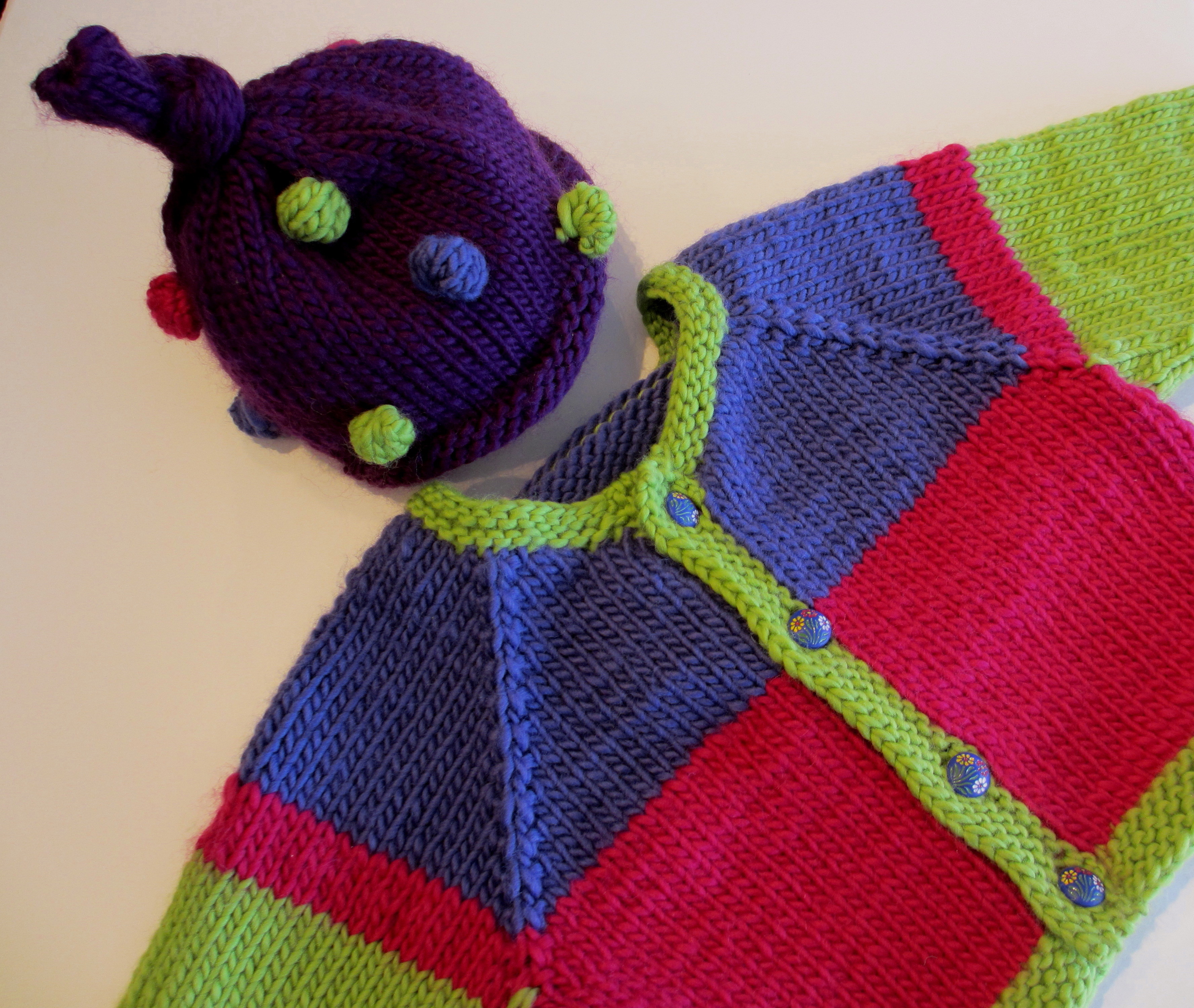
Baby Color Block Sweater

How do you knit cute?  Here’s the pattern for the baby color block sweater.
Bobbles and Top Knot Ensemble

Baby Color Block Sweater

Designed by Mary Lou Fall

Materials:

(5) Hanks Jil Eaton MinnowMerino, (100% extra fine superwash merino, 77 yds) (2) hanks green, (2) hanks pink, and (1) hank blue/purple

Circular Sizes 6 and 8

Double point needles Sizes 6 and 8

4 to 5 buttons, ¾ to 1 in.

Stitch markers

Gauge:

16 sts to 4 in. square over St st using size 8 needles, or size to obtain gauge.

Abbreviations

Kf&b – knit into the front and back of the st

ssk – slip one stitch as if to knit, slip the next stitch as if to purl, slip the tip of the left needle into the fronts of both stitches and knit them.

K2tog – knit two stitches together

Technique for Stitches

Stockinette st – When knitting in the round, knit every row.

Garter st – When knitting in the round, purl the first round, knit the second round.  Two rounds make 1 ridge.

Directions

The color block sweater is knitted in one piece, starting at the neck edge.  Directions are written for size 6 months with changes for larger size (up to 1 year) in parentheses.

Beginning at neck edge with blue/purple yarn and larger size 24 in. needle, cast on 2 sts, place marker, cast on 10 (11) sts, place marker, cast on 16 (17) sts, place marker, cast on 10 (11) sts, place marker, cast on 2 sts.  40 (43) sts.

Row 1:  Kf&b (knit into the front and back of the first st (first increase made) *inc, slip marker, inc k to within 1 st of next marker* rep at each marker to last st, inc. (10 increases)

Row 2:  Purl

Row 3:  Inc, *k to within 1 st of next marker, inc, slip marker, inc*, rep at each marker, k to last st, inc.

Work rows 2 and 3 until there are 22 (23) sts between the back markers.  At the end of the last increase row, cast on to the right tip of the needle 3 sts.

Purl the next row and at the end, cast on to the right tip of the needle 3 sts as before.

Row 1:  On the next row, *knit to within 1 st marker, inc, inc*, rep at each marker, k to end of row.

Row 2:  P

Continue to work the last 2 rows, and change to pink yarn when you have 36 (41) sts between the back markers. Increase as established until there are 40 (45) sts between the back markers, ending after a p row.

Divide for Sleeves

Knit to first marker and remove, k1.  Slip all the sts between here and the next marker on to a stitch holder for the left sleeve.  Cast onto the right tip of the needle 5 sts and join to the back sts.  Knit across the back sts to the next marker, k1, slip all the sts between here and the next marker onto a stitch holder for the right sleeve.  Cast on 5 sts as before and join to front sts.  Knit to the end of the row.

Body

Work in stockinette st until work measures 9-1/2 (10-1/2) inches measuring from the top of the shoulder.  Change to green and using smaller 24 in. circular needle, work ¾ “of garter stitch.  Bind off loosely.

Neckband

Right front (as worn):  Join green yarn with right side of work facing you using smaller circular needle, pick up 8 sts across front, 10 (11) across top of sleeve, 16 (17) sts across back neck, 10 (11) across top of other sleeve and 8 sts across other front.  Work 2 ridges of garter stitch.  Bind off loosely.

Sleeves

Slip the sleeve sts off stitch holders onto 2 of the larger size double point needles.  With right side of work facing you, using a third double point needle, join green yarn to right edge of armhole and pick up 7 sts across the armhole, placing a marker after three.  This is the beginning of the round.

Rnd 1:  Knit one round

Distribute the sts evenly between the other needles.

Rnds 2-6:  Knit

Rnd 7:  K1, ssk, k to within 2 sts of marker, k2tog

Knit 4 more rounds for the smaller size OR knit 3 more rounds for the larger size.

Repeat Rnd 7

Work as established, decreasing every 5 (4) rounds, until sleeve measures 5-1/2” (6”) measured from armhole, or ¾” less than desired length.

Continue decrease round (Rnd 7) until 24 (26) sts remain.  Change to smaller double point needles and work 2 ridges of garter stitch.  Bind off loosely.

Front Bands

NOTE:  If the sweater is for a girl make the buttonholes on the right band.  For a boy, make the buttonholes on the left band.  Begin picking up stitches at the lower edge of right front with knit side of work facing you for the right band.  For the left band, begin picking up at the neck edge of the left front with the knit side of work facing you.

With knit side of the work facing you, pick up 3 sts for every 4 rows using the smaller circular needle and green yarn. Count these sts and make a note.  Mark buttonholes using safety pins, mark 2 sts for each buttonhole desired, spacing them evenly, about 2-1/2” apart with the first buttonhole 2 sts from the upper edge.

Buttonhole row: 

*Knit to marked sts, bind off* rep until all pinned sts are bound off, k to end of row.  On next row, *k to bound off sts, cast on 2 sts*, rep to end of band.  Knit every row until there are 2 garter st ridges.  Bind off loosely.

 **Every effort has been made to provide complete and accurate instructions.


Baby Top Knot and Bobbles Ensemble

Recently, I was asked to design a baby color block sweater and hat.  Knitting top down is a perfect opportunity to color block a sweater.  In addition, adding bobbles and a top knot to a baby hat provides just the right “cuteness.”

Baby Top Knot with Bobbles HatBobbles and Top Knot Ensemble

Designed by Mary Lou Fall

Materials:

Size 8 double point needles

One skein of Jill Eaton MinnowMerino (100% extra fine superwash merino, 77 yds)

Yarn stash for bobbles

Gauge:             4 sts/inch

Directions:

CO 60 sts and divide evenly between three double point needles.  Join, being careful not to twist sts.

Rnd 1: Purl

Rnd 2: Knit

Rnd 3: Purl

Rnd 4: Knit, increasing 4 sts evenly.   Knit until hat measures 3-3/4” from cast on edge.

Decreasing for the Crown:

Rnd 1: *K2, K2 tog, *repeat to end of round.

Rnds 2-5:        Knit

Rnd 6: Repeat Rnd 1 (decrease)

Rnds 7-9:        Knit

Rnd 10:           Repeat Rnd 1 (decrease)

Rnds 11-12:    Knit

Rnd 13:           *K2 tog, *repeat to end of round.

Knitting the Top Knot

Work remaining sts for approximately 3”; break yarn leaving a 4” tail.  Thread tail onto yarn needle, thread tail through remaining sts; pull snug and fasten off.  Tie the length of knitting into a knot.  Weave in ends.

Bobbles:

Cast on 1 st, leaving a 4” tail.  Knit into the front, back, front, back and front of cast on st.  (5 sts).

Row 2:            P5

Row 3:             K5

Repeat rows 2 and 3 twice. (4 rows)

Row 6:            Pass 2nd, 3rd, 4th and 5th sts, one at a time, over the first st.  Fasten off, leaving a 4” tail.  Fold bobble in half and pull both tails through to WS of hat and secure.

*Of course, any yarn that gives the correct gauge may be used.

**Every effort has been made to provide complete and accurate instructions.

Darn Good Yarn

At Stitches West this year, I ended up attending a Market Session with a fellow knitter. The two of us are familiar with knitting short rows, but wanted to learn a little more about Japanese short row shaping.  The session did answer our questions and we plan on getting together again to explore machine knitting.

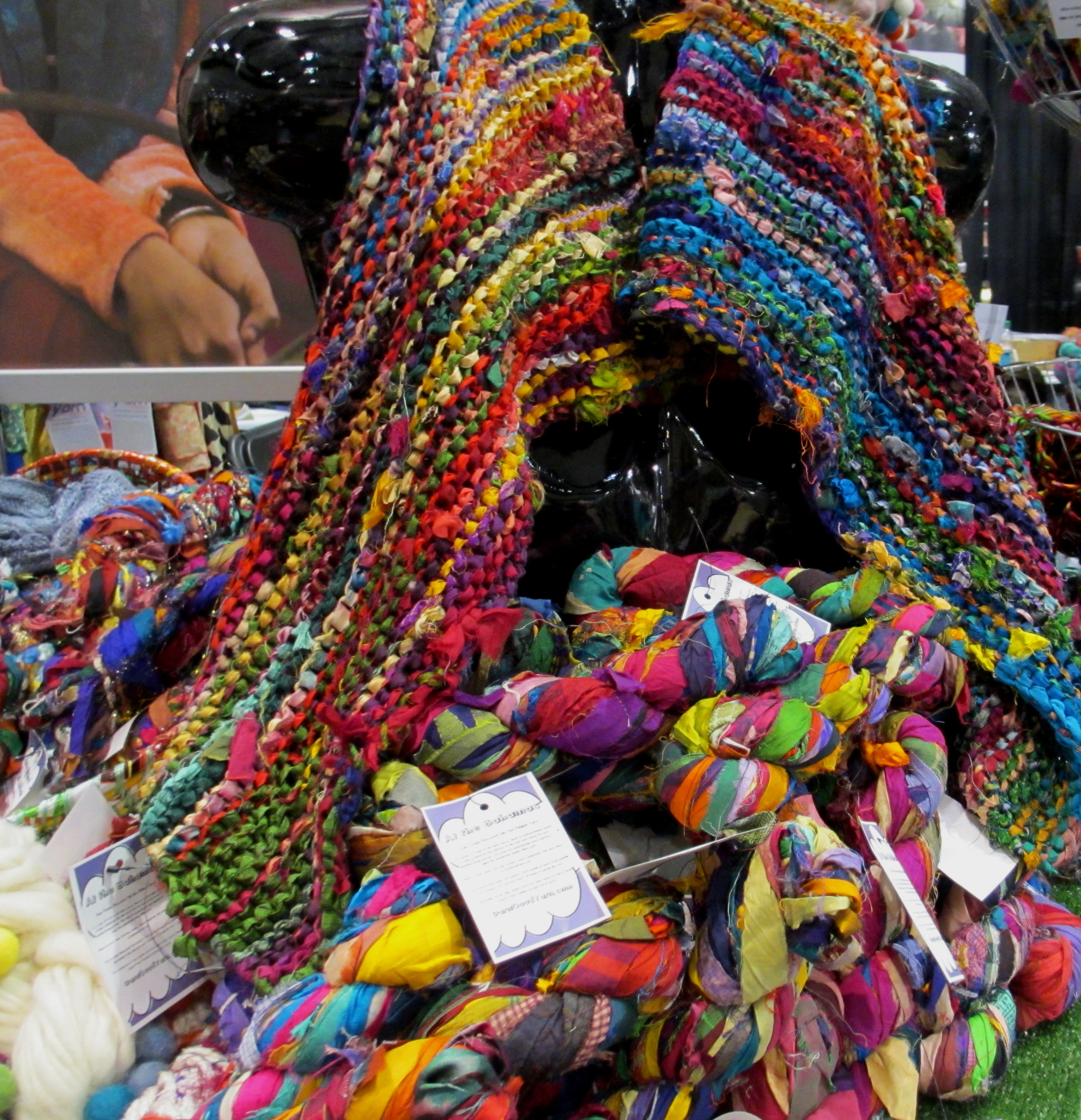
Upon leaving the session, I accidentally discovered Darn Good Yarn http://www.DarnGoodYarn.com.  A situation separated by the present transported me to a world saturated with color, print and texture.  Darn Good Yarn is “made from reclaimed sari silk at a co-op in India that empowers women.” This endeavor supports 300 families, plus 25,000 lbs of waste is saved each year.

Darn Good Yarn Booth #3 Darn Good Yarn Booth #2_1Darn Good Yarn Booth

Nicole, Founder, Maggie, Vice-President and Jessica, Community Manager are helpful, willing to answer questions, knowledgeable about the product, free w/purchase  pattern support for the yarn, and are enthusiastic about their endeavor.

I’ve started knitting a shrug, and plan on knitting “Adventure Cardi” designed by Denae Merrill with reclaimed chiffon.

Darn Good Yarn #2

Darn Good Yarn

Getaway

It was time for a mini-getaway.  A chance to unwind and regenerate.  An opportunity to visit two of our favorite restaurants.  Time to experience solitary moments of peace and quiet.  While beach combing, sifting through grains of sand looking for the perfect piece of sea glass, I did not expect to find a smiling face staring back at me.  I’m sure we’ve all looked at clouds and identified something familiar or seen religious figures on toast, but to actually see a smiling human face in a fossil shell took my breath away.  In one solitary moment, it felt good to have a face smile back at me.  Human face processing or  (face pareidolia) continues to be studied.  I found quite a bit of sea glass too, but nothing can compare to a smiling face.IMG_4052

Getaway #5Getaway #6

My Colour Wheel

Useful information with an assortment of beautiful examples.

marissafh's avatarMarissaFH Makes ...

This is a post that had been brewing for some time now, revisited after I started weaving, and now with two recent posts I read over the week – an anecdote about co-workers who didn’t know the primary and secondary colors on a color wheel, and an article about how to choose colors for a project.

Some time ago, I was asked how I came up with my color combinations, since they had difficulties or were challenged when choosing colors for their projects.  That got me to thinking about how I’ve used color in my projects.  I had taken art classes through the school years, and fiddled around with painting and drawing after – maybe that is why I don’t think much about color theories, it just sort of comes naturally when going through the stash or walking down the yarn aisle in a store.  Of course there’s a lot of the…

View original post 518 more words

Experiment or Mistake

Browsing through my pictures I discovered three experiments I never posted because I didn’t feel the outcome was worthy of a blog post.  Today, however, I find them quite interesting.  Should I consider these attempts an experiment or mistake?

Merriam-Webster Dictionary defines experiment as “A controlled procedure carried out to discover, or demonstrate something .” Mistake, “To blunder in the choice of.”

Felted Scarf and Wrap #1

Attempt #1: Originally, I did not find the colors appealing in the scarf I felted with the novelty yarn.  Now, I do.

Attempt #2: At the time, I thought the felted roving looked like a jumbled mess, but know the fiber looks like a spider web with a multitude of possibilities.

Last but not least, Attempt #3: The knitted block/rectangle was suppose to look like a log cabin quilt.  I wasn’t attracted to the outcome, but know I am pleased with the colors and texture created by the different yarn and color combinations.

I don’t consider these mistakes, they are experiments.  Perhaps our creative tastes evolve with time and experience.

Roving Spider WebLog Cabin